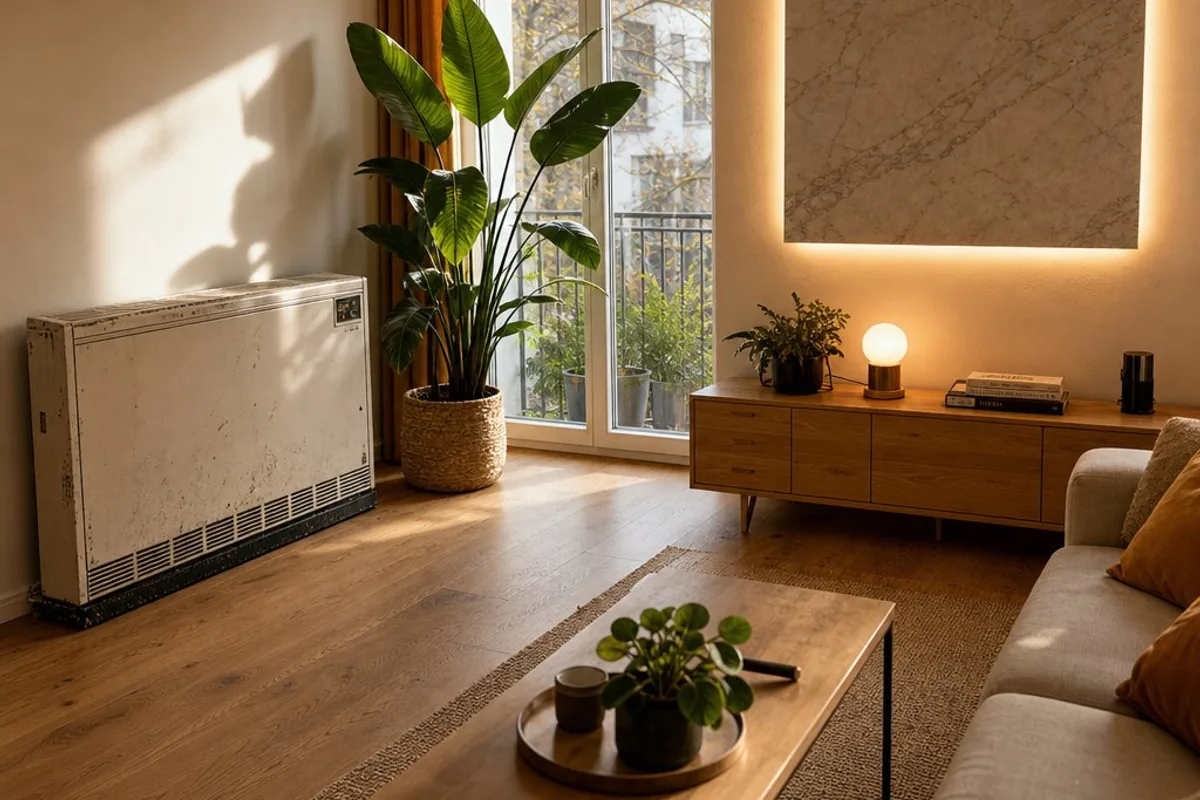
In countless Swiss apartments and single-family homes built between the 1960s and 1990s, it's still there — in the basement, in the hallway, or right in the living room: the electric storage heater. For decades it was a cheap, maintenance-free solution — charged overnight with low-cost off-peak electricity, releasing the stored heat during the day. Today, electric storage heating is a hot topic for three reasons: it is inefficient compared with modern systems, it falls under the gradual phase-out programme of the Climate Protection Act (KIG) and MuKEn 2025, and many units are over 30 years old and approaching the natural end of their service life. This article explains exactly what it costs to replace an electric storage heater in Switzerland in 2026, which deadlines apply in the cantons of Bern and Zurich, and why infrared zone heating is, for many households, the simplest and cheapest alternative.
What Is Electric Storage Heating — and Why Act Now?
An electric storage heater (also known as a night-storage heater) works on a simple principle: overnight, when electricity used to be cheaper, a heating element inside the unit charges a storage core made of refractory brick or magnesite to 600–700°C. Throughout the day, the unit releases this stored heat into the room via convection and some radiation. The system was attractive for decades because off-peak electricity used to be significantly cheaper than daytime electricity — a price gap that has largely disappeared from most Swiss electricity tariffs today.
Three problems make electric storage heating an obsolete technology in 2026: First, efficiency — heat output can barely be adjusted to actual demand, and much of the stored energy is released even when nobody is in the room. Second, age — most units are 25 to 45 years old, the storage core gradually loses capacity, and spare parts are increasingly hard to find. Third, regulation — the Climate Protection Act (KIG) and the cantonal implementations of MuKEn 2025 classify fixed electric resistance heaters, a category that includes electric storage heaters, as a technology being phased out.
Is Electric Storage Heating Banned in Switzerland?
The short answer: not overnight, but the clock is running. The Climate Protection Act, in force since January 2025, does not impose an instant ban on existing electric storage heaters. Instead, it requires that fixed electric resistance heaters — and electric storage heaters clearly fall into this category — be replaced with renewable or largely renewable systems within cantonally defined transition periods. The table below shows the current status for the most relevant cantons, with particular focus on Bern and Zurich, where most enquiries on this topic originate.
| Canton | Electric Storage Heater Deadline | Status | Notes |
|---|---|---|---|
| Canton Bern | 2030 | 2024 cantonal energy law | Replacement obligation applies immediately on failure; cantonal funding programmes available for replacement |
| Canton Zurich | 2030 | MuKEn 2025 implementation underway | Storage heaters explicitly classified as "fixed electric resistance heaters" |
| Canton Basel-Stadt | 2028 | Strictest deadline in Switzerland | New installations of electric storage heaters also banned |
| Canton Geneva | 2030 | 2024 energy law (Loi sur l'énergie) | Replacement with infrared + solar PV supported under the solar exception |
| Canton Lucerne | 2032 | MuKEn implementation in preparation | Longer transition period for rural areas |
| Other cantons | 2028–2035 | Varies | Check with your cantonal energy office |
Important if your unit fails: If your existing electric storage heater breaks down beyond repair before your canton's deadline, the replacement obligation typically applies immediately in most cantons — a like-for-like replacement with another storage heater is usually no longer permitted. Knowing this in advance lets you plan the replacement rather than making a rushed decision in an emergency.
Swiss Electric Heating Regulations at a Glance
If you're sifting through terms like KIG, MuKEn, cantonal energy law, and the solar exception, it's easy to lose track. Here's the short version of the rules that matter:
Climate Protection Act (KIG), in force since 1 January 2025: National framework law aiming to gradually phase fossil-fuel heating and fixed electric heating out of the Swiss building stock.
MuKEn 2025 (cantonal): The Mustervorschriften der Kantone im Energiebereich translate the KIG into concrete, cantonally varying deadlines — typically between 2028 and 2035, depending on canton and building type.
Solar exception: A fixed electric heater — including infrared panels — remains compliant if a solar PV system generates at least as much electricity over the year as the heater consumes, plus a 10% safety margin.
Heat pumps: Explicitly excluded from these restrictions, as they use electricity only to drive a process that extracts a multiple of that energy from the ambient environment.
For a detailed explanation of the legal situation, including the solar exception, see our article Electric Heater Ban Switzerland 2025–2030: What's Still Allowed.
What Does It Cost to Replace an Electric Storage Heater?
Cost is usually the deciding factor. Take a realistic scenario: a single-family home with 120 m² of living space and 5 rooms, each with an electric storage heater. The table below compares the main replacement options across upfront cost, annual running cost, and KIG compliance:
| Replacement Option | Purchase & Install | Running Cost/Yr | KIG 2025 Compliant |
|---|---|---|---|
| Heat pump (air-to-water, central) | CHF 30,000–40,000 | CHF 1,800–2,400 | Yes |
| Pellet heating (central) | CHF 25,000–32,000 | CHF 1,400–2,000 | Yes |
| District heating connection | CHF 8,000–15,000 | CHF 1,600–2,800 | Yes (where available) |
| Infrared zone heating (5 rooms, no solar) | CHF 2,750–4,400 | CHF 600–1,000 | Until cantonal deadline |
| Infrared zone heating + solar PV | CHF 8,000–12,000 | CHF 300–600 | Solar exception† |
†Fixed infrared panels run predominantly on self-generated solar electricity can qualify under the KIG/MuKEn 2025 solar exception — confirm the details with your cantonal energy office.
The difference in upfront cost is substantial — and that's precisely where the practical advantage of the infrared option lies. The chart below visualises the estimated investment cost for fully replacing the heating in the same 5-room, 120 m² single-family home:
A central heat pump is by far the most expensive option upfront — and in older buildings, an additional CHF 10,000–20,000 is often needed to convert the pipework to low-temperature distribution, since electric storage heaters have no hydraulic system that a heat pump could connect to directly. Infrared zone heating, by contrast, can be installed exactly where the old storage heater stood — same power supply, same location, no additional conversion work.
Replacing Decentralized Electric Heaters Room by Room
The biggest practical advantage when replacing decentralized electric heaters — individual storage units, convectors, or radiators in each room, as opposed to a central system with a distribution network — is that you don't have to replace everything at once. Every electric storage heater in your home is already a standalone unit with its own power connection. That's exactly the gap a SunWave Ceramica infrared panel fits into.
The process is simple: the old electric storage heater is disconnected (an electrician removes the high-voltage connection), the infrared panel is mounted on a wall or ceiling and plugged into a standard 230V socket. No new cabling, no work on the building structure, no building permit. The table below shows approximate costs depending on how many rooms you replace:
| Number of Rooms | Panels (650W, CHF 550 each) | Investment | Running Cost/Yr* |
|---|---|---|---|
| 1 room | 1 panel | CHF 550–750 | CHF 120–200 |
| 3 rooms | 3 panels | CHF 1,650–2,250 | CHF 360–600 |
| 5 rooms | 5 panels | CHF 2,750–4,400 | CHF 600–1,000 |
*Estimated for 4–6 hours of daily use per panel during the heating season, at CHF 0.28/kWh.
This staged approach is particularly relevant for rented apartments and condominiums, where a central heating overhaul often only happens during a full building renovation. If you're a tenant or the owner of a single unit and want to act now, decentralized infrared panels let you start immediately — independent of the building management's renovation timeline.
Practical tip: Start with the rooms you use most — living room, bedroom, home office. Rarely used rooms (guest rooms, storage rooms) can keep running on the old electric storage heater at its lowest setting until a replacement becomes necessary there too. This spreads the investment over several years without sacrificing comfort.
Step by Step: How to Replace Your Electric Storage Heater Correctly
Check the cantonal deadline and funding programmes
Contact your cantonal energy office (especially in Bern or Zurich, if applicable) and get written confirmation of the deadline that applies to your building. At the same time, ask about current funding programmes for replacing electric heaters.
Determine the heating load per room
Work out the heating output each room actually needs. As a rough rule of thumb, well-insulated Swiss homes need around 60–80W per m². A 15 m² room would need roughly 900–1,200W — covered by two SunWave Ceramica panels at 650W each, or one larger model.
Decide between central and decentralized
For an entire building with central water-based distribution, a heat pump can make sense — but it's significantly more expensive and, in older buildings, often involves additional conversion work. For replacing decentralized electric storage heaters room by room, infrared zone heating is the more economical and faster solution in most cases.
Check your solar PV potential
If your roof is suitable for a PV system, combining it with infrared panels is especially worthwhile: it further reduces running costs and can place the setup under the KIG/MuKEn 2025 solar exception — keeping it compliant as a primary heating system long term.
Arrange removal and installation
An electrician disconnects the old electric storage heater from the power supply and disposes of it properly (older units can contain refractory brick or asbestos components — professional disposal matters here). The infrared panels are then mounted and connected to the existing or a new socket — typically completed in a single day.
Funding and Tax Deductions
Even when replacing an electric storage heater, you can benefit from national and cantonal heating-replacement funding programmes. Heat pumps receive the most generous grants (CHF 5,000–15,000 depending on canton), pellet heating and district heating CHF 3,000–8,000. Most cantons offer no direct subsidy for infrared heating — however, the investment can often be deducted as maintenance costs over three tax periods, which has a meaningful effect given the comparatively low investment amount.
Important: In almost all cantons, funding applications must be submitted BEFORE construction begins. Secure written approval before placing your installation order — especially if you're relying on heat pump funding.
For a complete overview of heating alternatives, funding programmes, and the step-by-step process of replacing a heating system, see our article Replace Gas or Oil Heating in Switzerland 2026. To learn how to combine infrared heating with solar PV, visit our page Infrared Heating with Solar PV.
Frequently Asked Questions
Is electric storage heating banned in Switzerland?
Not directly and not immediately. The Climate Protection Act (KIG) and the cantonal MuKEn 2025 implementations classify electric storage heaters as fixed electric resistance heaters and set out a gradual phase-out schedule — with cantonal deadlines between 2028 and 2035. This is not an instant ban: you may continue operating a working electric storage heater until your canton's deadline. However, if the unit fails or is replaced before that date, the replacement obligation typically applies immediately in most cantons — replacing it with another like-for-like storage heater is usually no longer permitted.
How much does it cost to replace an electric storage heater?
It depends heavily on the alternative chosen. For a typical 5-room single-family home (120 m²), a central heat pump including installation costs CHF 30,000–40,000, and a pellet heating system CHF 25,000–32,000. An infrared zone heating setup using SunWave Ceramica panels (650W, CHF 550/panel) for the most-used rooms, by contrast, often costs only CHF 2,750–4,400 for 5–8 panels — combined with a solar PV system, the total investment is around CHF 8,000–12,000, which then qualifies as a fully compliant primary heating system under the solar exception.
What deadline applies to electric heating in the cantons of Bern and Zurich?
Both cantons currently target 2030 as the implementation year for MuKEn 2025 requirements on fixed electric heating, including electric storage heaters. In the canton of Bern, the 2024 cantonal energy law sets out the details and offers funding programmes for replacement; in the canton of Zurich, the ongoing MuKEn 2025 implementation explicitly classifies storage heaters as "fixed electric resistance heaters." In both cantons, if your existing unit fails before 2030, the replacement obligation generally applies immediately. Confirm the exact deadline and any exemptions with your cantonal energy office.
What are the general rules for electric heating in Switzerland?
Three frameworks work together: the national Climate Protection Act (KIG, in force since January 2025) sets the overarching goal of a fossil- and electric-heating-free building stock. The Mustervorschriften der Kantone (MuKEn 2025) translate that goal into concrete cantonal deadlines and exemptions — each canton implements these individually. And the solar exception allows a fixed electric heater (including infrared panels) to remain in use as a primary heating system if a solar PV system generates at least as much electricity over the year as the heater consumes, plus a 10% safety margin. Ultimately, the cantonal energy law of your home canton is what governs.
Can I replace a decentralized electric heater with infrared?
Yes, and in practice this is often the simplest solution. Decentralized electric heaters — individual convectors, radiators, or storage units in each room — can be replaced room by room with SunWave Ceramica infrared panels, without any work on water pipes, flooring, or the building envelope. Each panel only needs a standard 230V socket and can be installed by an electrician in a few hours. This lets you proceed in stages — starting with your most-used rooms, then others — spreading the investment over several years instead of finding CHF 30,000+ for a central system all at once.
Replace room by room — starting at CHF 550
The SunWave Ceramica panel: 650W, 6mm porcelain stoneware, CE-certified, independently tested by Fraunhofer WKI, TU Dresden, and Labor S.A. 5-year warranty. Plugs into the same socket as your old electric storage heater.
View the SunWave Ceramica Panel →