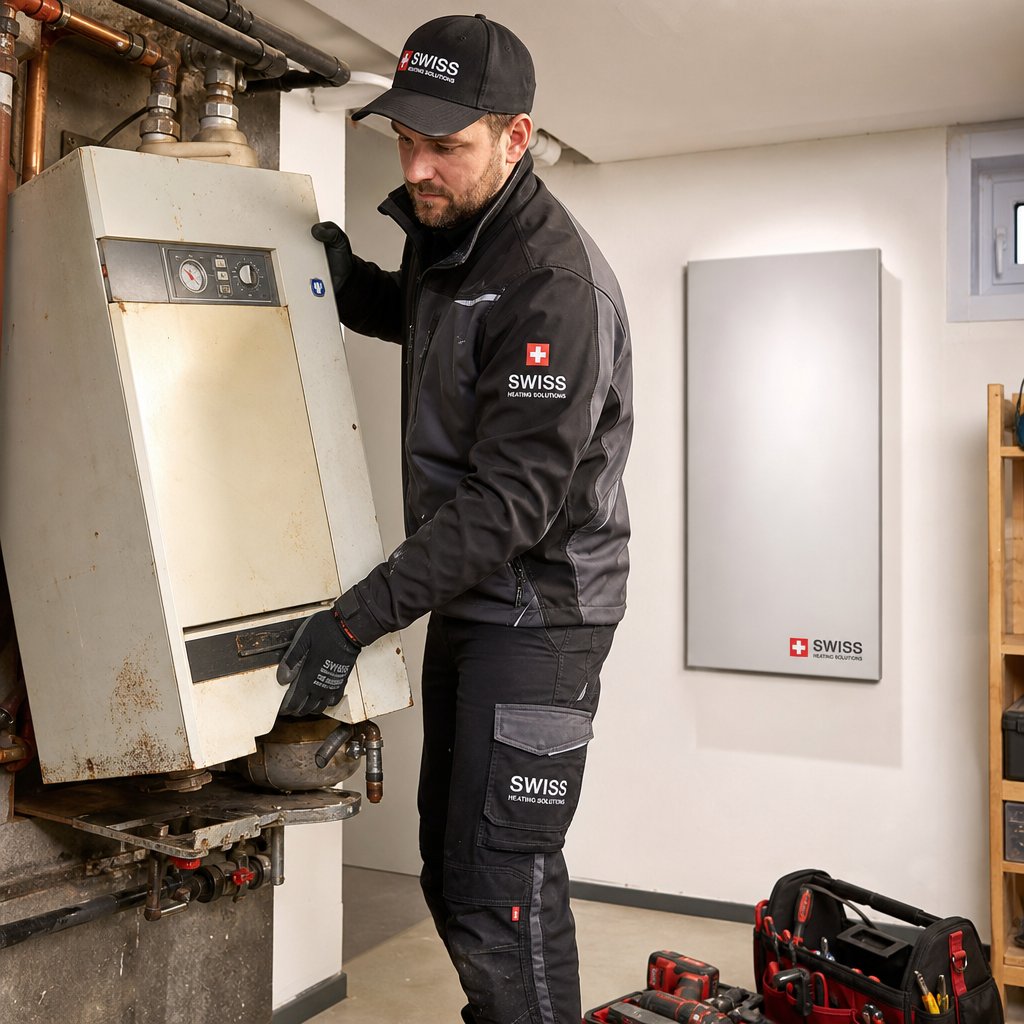
More than half of Swiss buildings are still heated by fossil fuels — gas or oil. As the Climate Protection Act (KIG) takes effect and boiler replacement cycles approach, hundreds of thousands of Swiss property owners face the same decision: what do I replace my old boiler with, and how much will it cost?
This article provides a clear, honest comparison of the four main compliant alternatives. We examine upfront investment, annual running costs, installation complexity, and suitability for different building types — so you can make a well-informed decision for your specific situation.
Why Switzerland Is Replacing Gas and Oil Heating
The Swiss Climate Protection Act (KIG), in force since 1 January 2025, prohibits new fossil fuel heating installations in residential buildings. Existing gas and oil boilers do not need to be replaced immediately, but when they reach end of life or when a building undergoes major renovation, they must be replaced with a compliant alternative. New-for-like replacements — a new gas boiler for an old one — are no longer permitted.
This policy has been visible on the horizon for years, but many Swiss homeowners are now facing the practical reality as boilers installed in the 1990s and 2000s approach the end of their 20–25 year lifespan. The Swiss boiler replacement market is set to be one of the largest energy transition investment waves of the next decade.
The Economics of Delay
Some owners consider extending their existing gas boiler with emergency repairs or a like-for-like swap — but this is no longer a legal option. A new gas boiler cannot be installed as a primary heating system. An oil boiler replacement for an existing oil boiler falls under the same prohibition.
The economics of delay also worsen over time. Gas prices in Switzerland include a rising CO₂ surcharge that will increase each year through 2030. Every year spent on fossil heating is a year of above-inflation energy cost increases. The one-time transition cost is real, but it eliminates exposure to gas and oil price volatility permanently.
Replacing a 20-year-old gas boiler with another gas boiler is no longer permitted under KIG 2025. The decision is not whether to replace, but which compliant system to choose.
The 4 Compliant Alternatives — How They Compare
Here is a direct comparison of the four main compliant heating alternatives for a typical 100 m² Swiss residential property:
| System | Investment | Annual Running Cost | Install Complexity | KIG 2025 Compliant |
|---|---|---|---|---|
| Air-source Heat Pump | CHF 35,000–52,000 | CHF 800–1,200 | High | Yes |
| Ground-source Heat Pump | CHF 45,000–70,000 | CHF 600–1,000 | Very high | Yes |
| Pellet Boiler | CHF 20,000–35,000 | CHF 1,200–1,800 | Medium | Yes |
| Infrared + Solar PV | CHF 4,720 + solar | CHF 400–700* | Low | Solar exception† |
*Based on running each 650 W panel roughly 4–6 hours/day through the heating season, with 40–60% solar self-consumption; without solar, approximately CHF 1,000–1,400/year for the 8-panel system at CHF 0.28/kWh. †Fixed electric heating powered mainly by on-site solar PV can qualify for the KIG/MuKEn 2025 solar exception — confirm the details with your cantonal energy office and installer.
Air-Source Heat Pump
The most widely discussed option, and the Swiss government's primary recommended technology for residential heating replacement. An air-source heat pump extracts heat energy from outdoor air and upgrades it to usable heating temperatures via a refrigerant cycle. In well-insulated buildings, COPs of 3–4 are achievable, making it very energy-efficient on a per-kWh basis.
The limitations are significant, however. Installation requires an outdoor compressor unit (subject to noise regulations, especially in urban cantons), hydronic pipework throughout the building, a buffer storage tank, and — in older buildings — often a complete replacement of the heat distribution system (radiators to underfloor, or oversizing of existing radiators for lower-temperature operation). Total investment CHF 35,000–52,000 is typical; older or more complex buildings can exceed this.
Ground-Source Heat Pump (Geothermal)
More efficient than air-source, with COPs of 4–5 in normal Swiss ground conditions. Requires drilling of one or more boreholes (typically 150–200 m deep) for the ground loop — a process subject to cantonal permitting and geological surveys. Total investment CHF 45,000–70,000. The additional upfront cost and complexity make this the right choice for new builds and large renovations, but it is impractical for most existing residential buildings.
Pellet Boiler
A biomass option that burns compressed wood pellets from sustainably managed forests. Compliant under Swiss energy law as a renewable system. Running costs are moderate — pellets are less expensive per kWh than electricity, but more expensive than solar-covered infrared. Installation requires a dedicated boiler room, a pellet storage silo (typically 5–15 m³), and a chimney. Not suitable for apartments or buildings without space for the storage and flue requirements.
Infrared + Solar PV
The lowest-cost option on this list, and the most practical for apartments, smaller buildings, and properties where heat pump installation is challenging — see "When Infrared + Solar Is the Right Choice" below. SunWave Ceramica panels at CHF 550 each (thermostat included); a typical 8-panel installation (CHF 4,400) plus installation labour gives a total of approximately CHF 4,720. Each panel connects to a standard 230 V socket — no hydronic pipework, no boiler room, no outdoor unit.
Running cost depends on how the panels are used. As zone heating for the rooms occupied most, a 650 W panel run roughly 4–6 hours/day costs CHF 22–34/month at CHF 0.28/kWh — for an 8-panel system run through the heating season, that's roughly CHF 1,000–1,400/year before solar. Combined with a rooftop solar PV installation — which the majority of Swiss detached houses and many apartment buildings can accommodate — self-consumption typically covers 40–60% of that load, bringing running costs to roughly CHF 400–700/year. Fixed electric heating powered mainly by on-site solar PV can also qualify for the KIG/MuKEn 2025 solar exception — confirm the details with your cantonal energy office and installer. For the solar side of this combination, see SunWave for Solar Installers.
20-Year Total Cost of Ownership
Upfront investment is only part of the picture. Over a 20-year ownership period, running costs, maintenance, and mid-life component replacements all accumulate. Here is a 20-year total cost of ownership comparison for the four systems, based on a 100 m² Swiss residential property:
| Cost Category | Heat Pump (Air) | Pellet Boiler | IR + Solar |
|---|---|---|---|
| Initial investment | CHF 43,500 | CHF 27,500 | CHF 4,720 |
| Annual energy cost × 20 | CHF 20,000 | CHF 30,000 | CHF 11,000 |
| Annual maintenance × 20 | CHF 10,000 | CHF 16,000 | CHF 0 |
| Mid-life component replacement | CHF 5,000–8,000 | CHF 3,000–5,000 | CHF 0 |
| 20-Year Total | ~CHF 78,500 | ~CHF 76,500 | ~CHF 15,720 |
These figures use mid-range estimates. The infrared total assumes 40–60% solar self-consumption, bringing running costs to roughly CHF 400–700/year (≈CHF 11,000 over 20 years). Even without any solar self-consumption — at roughly CHF 1,000–1,400/year, or ≈CHF 24,000 over 20 years — the 20-year infrared total would be approximately CHF 28,720, still well below either the heat pump or pellet boiler scenario.
SunWave Ceramica panels have no moving parts, no refrigerant, no boiler, and no annual maintenance requirement. The 5-year warranty covers the product; the ceramic stoneware construction is designed for 30+ years of service.
Gebäudeprogramm Grants and Tax Deductions
Switzerland's Gebäudeprogramm — funded by the federal CO₂ levy — provides financial support for building energy improvements, including heating system replacements. Understanding what is available can meaningfully reduce your net investment.
What the Gebäudeprogramm Covers
The programme primarily subsidises heat pump installations and building envelope improvements (insulation, windows). Grant amounts vary by canton, system type, and building category. For a typical air-source heat pump installation in a single-family house, grants of CHF 4,000–10,000 are common — partially offsetting the much higher upfront cost.
For infrared heating as part of a broader energy renovation package, eligibility varies by canton. Some cantons permit infrared panels within renovation grant packages where the overall building energy performance improvement meets the threshold. Consult your cantonal energy office (Energiefachstelle) or a certified GEAK energy advisor for current programme terms.
Tax Deductibility
In most Swiss cantons, energy renovation costs — including heating system replacement — are tax-deductible for property owners. The deduction applies to the investment cost in the year of installation, or spread over multiple years depending on cantonal rules. For a CHF 4,720 infrared installation, the tax benefit at a 25% marginal rate would be approximately CHF 1,180. For larger heat pump installations, the tax benefit is proportionally larger, but so is the required investment.
When Infrared + Solar Is the Right Choice
Infrared heating is not universally the best solution for every building in Switzerland. But for a significant subset of the market, it is demonstrably the most practical and economical path.
Infrared + Solar Works Best For:
Apartments and flats: The majority of Swiss homes are apartments. Most apartments cannot accommodate an outdoor heat pump compressor unit, cannot access shared roof space for ground source, and do not have boiler room space for pellets. Infrared panels mounted on room walls or ceilings — connected to standard sockets and controlled individually per room — are a natural fit. Combined with a building-level solar installation or balcony PV, compliance is achievable.
Listed heritage buildings (Denkmalpflege): Switzerland's strict heritage protection framework often prohibits the structural works required for hydronic heat pump systems. Infrared panels can be installed reversibly, without structural penetrations, using standard electrical connections. Heritage authorities in multiple cantons have approved infrared heating in protected buildings where heat pumps were not permitted.
Holiday homes and mountain chalets: Intermittent occupancy makes the heat pump's higher efficiency at steady-state operation less relevant. Infrared heats a cold room to comfort temperature within 30–45 minutes. There is no risk of freeze damage to pipework, no minimum outdoor temperature requirement, and no seasonal service call needed before the first winter use.
Landlords and property investors: The low upfront cost, zero maintenance, and room-by-room control make infrared particularly attractive for rental properties. Individual room thermostats allow tenant-level energy management without complex building management systems.
Solar PV owners and installers: A rooftop solar system combined with SunWave Ceramica panels is a high-performance, KIG-compliant heating package with excellent payback characteristics. The infrared load is perfectly matched to midday solar generation peaks. See SunWave for Solar Installers for load profiles and self-consumption calculation tools.
Where Other Systems May Be More Suitable
Very large buildings (over 300 m²) with excellent insulation and existing hydronic distribution infrastructure may achieve better long-term running cost economics with a ground-source heat pump, where the higher COP offsets the greater investment. Buildings already connected to a district heating network that is fed by renewable sources should evaluate district heating carefully — where the connection cost is reasonable, it can be highly efficient and low-maintenance.
How to Get Started
If you are replacing gas or oil heating in Switzerland and want to understand whether infrared + solar is right for your building, here is a practical three-step path:
Step 1: Commission a GEAK energy certificate. The GEAK (Gebäudeenergieausweis der Kantone) provides an independent energy audit of your building. It documents current energy performance, identifies the highest-impact improvements, and is often required to access Gebäudeprogramm grants. Many cantonal energy offices offer subsidised GEAK assessments. Cost: CHF 400–1,200 depending on building size and complexity.
Step 2: Assess your solar potential. Most Swiss cantons offer free initial solar potential assessments through their energy offices or the federal Sonnendach tool (available at energieschweiz.ch). This will tell you how much annual solar energy your roof can realistically generate — the key input for sizing both the PV system and the infrared heating load.
Step 3: Request a quote from SunWave Switzerland. We provide free heating system sizing based on your floor plan and building characteristics. We will calculate the number of panels required, estimated annual energy cost, and total investment. Contact us at sunwaveswitzerland.com/contact or by phone at +41 76 763 74 90.
For a full overview of how infrared heating works and what the independent test evidence shows, see: Infrared Heating Switzerland: The Complete Guide 2026. For the specific legal position on electric heating under KIG 2025, see: Electric Heater Ban Switzerland 2025–2030: What's Still Allowed.
Frequently Asked Questions
Is it mandatory to replace gas heating in Switzerland?
Yes, under the Swiss Climate Protection Act (KIG) which entered into force on 1 January 2025, new fossil fuel heating systems (gas, oil) are no longer permitted as primary heating in residential buildings. Existing systems must be replaced with a compliant alternative at end of life or when the building undergoes major renovation. There is no requirement to replace a functioning system immediately, but new-for-like fossil fuel replacements are no longer possible.
What is the cheapest replacement for gas heating in Switzerland?
On upfront investment, infrared heating panels combined with solar PV are by far the cheapest option — approximately CHF 4,720 for an 8-panel system (panels and installation), compared to CHF 35,000–52,000 for an air-source heat pump. Whether infrared + solar alone can serve as your primary heating depends on your building's size, insulation, and the rooms you need to heat — for many apartments, heritage buildings, and holiday homes it's a strong fit, while larger or less-insulated homes generally do better pairing infrared with a heat pump or other renewable system. With good solar roof exposure, running costs for an 8-panel system are roughly CHF 400–700/year.
Does infrared heating qualify as a replacement for gas heating in Switzerland?
In many cases, yes — but it depends on your canton and building. Fixed electric heating (including infrared panels) powered mainly by on-site solar PV can qualify under the KIG solar exception and MuKEn 2025. This pathway is well-established for apartments, heritage buildings, holiday homes, and similar properties, but implementing guidance varies by canton — confirm your specific situation with your cantonal energy office (Kantonales Amt für Energie) before relying on it for a boiler-replacement decision.
How much does it cost to replace a gas boiler with infrared heating?
A complete SunWave Ceramica infrared heating system for a 100 m² home — 8 panels plus installation — costs approximately CHF 4,720. If solar PV is not already installed, a rooftop system adds CHF 12,000–25,000 depending on size, but this cost is largely offset by electricity savings and feed-in tariffs over 10–15 years. Compare this to CHF 35,000–52,000 for an air-source heat pump (heating component only).
Make the switch — for less than you think
SunWave Ceramica: the fast, low-cost path from gas to compliant renewable heating. Free sizing consultation available for Swiss properties.
Book a Free Consultation →