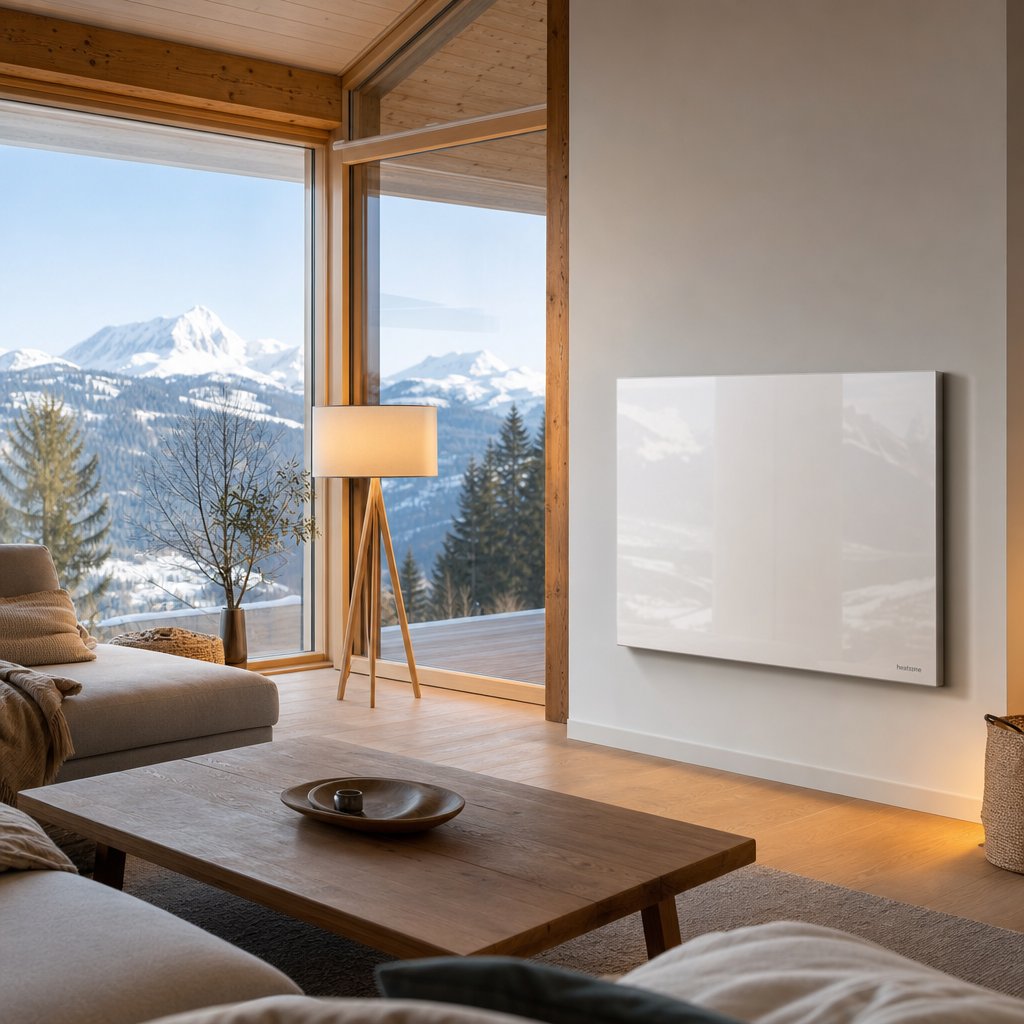
Switzerland is searching for infrared heating at record rates. As the Climate Protection Act (KIG) reshapes the country's heating landscape and energy prices remain elevated, thousands of Swiss homeowners, landlords, and building managers are asking the same question: is infrared heating a real, practical, cost-effective option — or just a niche technology?
This guide answers that question comprehensively. We cover the science, the Swiss legal situation in 2026, real cost figures, and the independent test data that sets SunWave Ceramica apart from cheaper alternatives.
What Is Infrared Heating?
Infrared heating is a fundamentally different approach to warming a space. Traditional convective heaters — radiators, fan heaters, electric storage heaters — warm the air. The warm air rises, creates draughts, distributes dust and allergens, and loses significant energy to the ceiling before it reaches the people and surfaces in the room.
Infrared heating works by emitting electromagnetic radiation in the far-infrared spectrum (approximately 5–15 µm wavelength), which is directly absorbed by walls, floors, furniture, and the human body. The sensation is immediately noticeable: a gentle, even warmth comparable to sunlight, without the dry air and temperature stratification typical of convective systems.
The Technology Behind SunWave Ceramica
SunWave Ceramica panels achieve this effect through a patented magneto-caloric paste technology (Patent EP 3 123 483 B1). The heating element is embedded in 6 mm fine porcelain stoneware — the same material used in high-end architectural cladding. This is not a sheet of painted aluminium. The ceramic has genuine thermal mass: it stores heat, moderates temperature swings, and re-radiates warmth gently after the heating cycle ends.
The standard panel format is 60 × 120 cm, designed to mount flush against a wall or ceiling. Wattages range from 300 W to 700 W depending on room size requirements. Each panel connects to a standard 230 V socket via a thermostatic controller — no special installation beyond a wall bracket and a socket.
SunWave Ceramica is backed by three independent laboratory certifications: TU Dresden (radiation efficiency & spectral performance), Fraunhofer WKI (indoor air quality), and Labor S.A. (electrical safety).
How Infrared Heating Works: The Physics of Radiant Warmth
To understand why infrared heating is more efficient than convective heating, it helps to understand a fundamental principle of thermodynamics: Planck's law. Every object above absolute zero emits thermal radiation. The wavelength of peak emission depends on temperature. The human body feels most comfortable when absorbing radiation in the far-infrared band (8–14 µm) — the same band produced by warm surfaces.
A SunWave Ceramica panel operating at its design temperature emits radiation peaking at 8.52 µm, as independently measured by TU Dresden under DIN EN IEC 60675-3. This places it almost exactly at the peak of the far-infrared window most efficiently absorbed by water molecules in building materials and organic matter.
Why Walls Store Heat Better Than Air
When an infrared panel radiates energy, it heats the walls, floor, ceiling, and furniture of the room — not primarily the air. These surfaces have much greater thermal mass than air. A brick wall, a tiled floor, or a heavy piece of furniture can absorb and store many times more heat energy per degree of temperature rise than the same volume of air.
The practical consequence is significant: infrared-heated rooms stay warm for longer after the heating cycle ends, require shorter active heating periods to maintain comfort, and exhibit much less temperature stratification between floor and ceiling. The air temperature in an infrared-heated room can be 1–2°C lower than in a convectively-heated room while still feeling just as warm — because the radiant temperature of the surrounding surfaces compensates.
This "mean radiant temperature effect" is not a marketing claim. It is the basis of thermal comfort standards in building physics (ISO 7730) and explains the consistent real-world energy savings observed across all independent studies of infrared heating.
Infrared Heating in Switzerland — Legal Position 2026
The Swiss heating market changed fundamentally on 1 January 2025, when the Federal Climate Protection Act (Klimaschutzgesetz, KIG) entered into force following the June 2023 referendum. Understanding what it says — and what it does not say — is essential for any Swiss property owner considering their heating options.
What the KIG Actually Prohibits
The KIG targets fossil fuel heating systems at end of life: gas boilers, oil furnaces, and coal-based systems must be replaced with compliant alternatives when they reach the end of their operational life or when a building undergoes major renovation. The law also restricts new installations of fixed electric resistance heaters used as primary heating in residential buildings without a renewable energy source.
This is a crucial distinction. The KIG does not prohibit electric heating per se — it targets pure grid-electricity resistance heating as a primary heat source. Systems powered by on-site renewable energy are explicitly exempted.
MuKEn 2025 and the Solar Exception
The cantonal Model Energy Regulations (MuKEn 2025) implement the KIG at cantonal level and contain the key provision for infrared heating: fixed electric heating systems powered by on-site renewable energy (solar PV) are exempt from the phase-out. A building where at least a defined share of annual heating energy comes from self-generated solar power qualifies as compliant.
SunWave Ceramica panels powered primarily by a rooftop solar PV installation can fall within this exemption — worth raising with your installer and canton if solar-powered electric heating is part of your plan. For most homes, infrared panels work best as a complement to a primary heating system (heat pump or similar) rather than as the sole heat source for the whole building.
Solar exception under KIG/MuKEn 2025: fixed electric heating (including infrared panels) powered mainly by on-site solar PV can qualify for the exemption from the resistance-heating phase-out. Confirm the details with your canton and installer.
For more detail on the legal position, see our dedicated article: Electric Heater Ban Switzerland 2025–2030: What's Still Allowed. If you are replacing a gas boiler, see: Replace Gas or Oil Heating in Switzerland 2026: Best Alternatives Compared. If you are a solar installer or work with PV systems, visit SunWave for Solar Installers.
The Cost of Infrared Heating in Switzerland
Cost only makes sense in context of what each system is for. A heat pump and an infrared panel are not competing for the same job — so the honest comparison isn't "which is cheaper per kWh," but "which costs more to solve the problem you actually have."
Investment Costs
| System | Hardware | Installation | Total Investment |
|---|---|---|---|
| SunWave Ceramica (per panel) | CHF 550 | CHF 0 — plug-in | CHF 550 |
| Whole-home air-source heat pump | CHF 28,000–40,000 | CHF 7,000–12,000 | CHF 35,000–52,000 |
These solve different problems. A heat pump replaces your whole-home heating system. SunWave Ceramica adds comfortable, controllable warmth to specific rooms — a cold bedroom, a home office, a bathroom — for a fraction of the cost and with zero installation work. For most Swiss homes, the two work best together: a heat pump for the building, infrared for the rooms it runs cold.
Running Costs
A SunWave Ceramica panel is rated at 650 W. Running one panel for around 4–6 hours a day — typical for a room you use in the evening or morning — draws roughly 80–120 kWh per month, costing approximately CHF 22–34/month per panel at Switzerland's average electricity price of CHF 0.28/kWh.
Because the radiant warmth lets you keep the air temperature 1–2°C lower for the same comfort (see "How Infrared Heating Works" above), the panel's own running cost is partly offset by reduced demand on your main heating system in that room. Actual usage depends on the room, its insulation, and how many hours the panel runs.
If the panel is powered partly or wholly by rooftop solar PV, much of this cost can be covered by self-generated power during daylight hours — particularly relevant for home offices and rooms used during the day.
Independent Test Results
SunWave Ceramica is one of the most independently tested infrared heating products available in Switzerland. The following results are not manufacturer claims — they are findings from accredited external laboratories.
TU Dresden — Spectral & Radiation Performance
TU Dresden tested SunWave Ceramica under DIN EN IEC 60675-3, the international standard for infrared heater performance, and confirmed the panel's radiation efficiency meets the specification. The measured peak emission wavelength is 8.52 µm, placing it squarely in the far-infrared band most efficiently absorbed by the human body and by building materials — the basis of the comfort effect described above.
Fraunhofer WKI — Indoor Air Quality
Fraunhofer Wilhelm-Klauditz-Institut (WKI), Germany's leading independent institute for materials and indoor air quality, tested SunWave Ceramica for volatile organic compound emissions. Total VOC emissions measured just 0.043 mg/m³ — far below regulatory limits, with no carcinogenic compounds detected, including formaldehyde, benzene, and toluene. This matters in Switzerland's well-insulated buildings, where indoor air quality is directly affected by heating system emissions.
Labor S.A. — Electrical Safety
Labor S.A. (Greece) certified SunWave Ceramica to EN 60335-2-30, the core safety standard for fixed electric room heaters. All clauses passed: surface temperature rise of 71.2 K stayed within the 80 K limit, and leakage current measured 0.1 mA against a 0.25 mA limit — confirming the integrity of the Class II double-insulated construction.
Three independent certifications: TU Dresden (radiation efficiency, peak 8.52 µm), Fraunhofer WKI (0.043 mg/m³ TVOC), Labor S.A. (EN 60335-2-30, all clauses pass). See the full data at Research & Evidence.
Who Should Use Infrared Heating in Switzerland?
Infrared heating is not the right solution for every building — but it is an excellent solution for a wide range of Swiss properties.
Best Applications
Old buildings without central heating: Many Swiss Altbauten (pre-1970 buildings) have electric convective heaters room by room. Replacing these with infrared panels is a direct one-for-one upgrade: same circuit, same sockets, dramatically lower energy consumption.
Holiday apartments and chalets: Intermittent heating is where infrared excels. Because it heats surfaces directly rather than air, a holiday home can reach comfort conditions within 30–40 minutes of arrival — faster than any hydronic system. There is no standing pilot light, no boiler maintenance, no antifreeze requirement.
Listed heritage buildings: Switzerland's strict heritage protection laws often make invasive heating installations impossible. Infrared panels can be installed without structural works, ductwork, or boiler rooms.
Supplementary heating: Even in buildings with existing central heating, infrared panels in bathrooms, home offices, or basement rooms provide targeted warmth without heating the entire system. See our dedicated guides: Infrared Heating Ceiling Mount Switzerland and Infrared Heater Bathroom Switzerland.
Solar PV combination: The optimal use case for SunWave Ceramica is paired with rooftop solar. The panels act as a thermal battery, absorbing midday solar surplus and releasing it as room warmth. See SunWave for Solar Installers for load-matching details and self-consumption calculations.
Where Infrared Is Less Suitable
Very large commercial buildings over 300 m² with poor insulation may be better served by a centralised heat pump combined with underfloor heating, where the coefficient of performance justifies the higher investment. For anything under 300 m² — including virtually all Swiss apartments, terraced houses, detached houses, and small commercial premises — infrared is a credible primary heating option.
SunWave Ceramica — What Makes the Difference?
The Swiss market has seen a proliferation of cheap infrared panels — mainly thin aluminium sheets with a printed surface. Understanding what sets SunWave Ceramica apart is important when making a long-term heating investment.
6 mm Porcelain Stoneware — Genuine Thermal Mass
SunWave Ceramica uses 6 mm fine porcelain stoneware — the same material used in premium architectural cladding. Ceramic has approximately 4× the thermal mass of aluminium per unit volume. This means the panel heats more slowly, stores more energy, and continues radiating warmth for 15–25 minutes after the heating cycle ends. The result is a more stable, comfortable room temperature with fewer on-off cycles.
Fraunhofer-Certified Indoor Air Quality
Cheap infrared panels can off-gas VOCs when heated, especially if the coating is not properly cured or tested. SunWave Ceramica has been independently tested by Fraunhofer WKI: total VOC emissions measured just 0.043 mg/m³ — far below regulatory limits, with no carcinogenic compounds detected, including formaldehyde, benzene, and toluene. This is particularly important in Swiss homes where buildings are well-sealed and ventilation is controlled.
Patented Technology
The magneto-caloric paste embedded in the ceramic is protected by European Patent EP 3 123 483 B1. This technology optimises heat transfer from the electrical element to the ceramic surface, reducing hot spots and ensuring even temperature distribution across the entire panel face.
Full Certification Stack
CE marking, ISO 9001 (quality management), ISO 14001 (environmental management), and ISO 45001 (occupational health and safety). These are not marketing badges — they represent independently audited manufacturing processes and consistent product quality. Combined with a 5-year warranty, SunWave Ceramica is a product built for the Swiss market's standards.
Frequently Asked Questions
What is infrared heating?
Infrared heating uses electromagnetic radiation in the far-infrared spectrum (5–15 µm) to heat surfaces, walls, and objects directly — not the air. Unlike convective heaters that heat air (which then rises and loses heat), infrared panels transfer energy directly to solid surfaces, which store warmth and re-radiate it gradually. The result is a more even, stable, and efficient heat comparable to sunlight on your skin.
How much does infrared heating cost in Switzerland?
SunWave Ceramica panels start from CHF 550 per panel including VAT, the WiFi thermostat, and a 5-year warranty. A complete system for a 100 m² home — 8 panels plus installation — costs approximately CHF 5,200 in total. This compares very favourably with a heat pump installation at CHF 35,000–52,000.
Is infrared heating still legal in Switzerland?
Yes. Switzerland's Climate Protection Act (KIG), in force since January 2025, restricts fixed electric resistance heaters used as the primary heating system. However, the law contains a solar exception: fixed electric heating powered mainly by on-site solar PV can qualify under KIG and MuKEn 2025 — worth confirming with your canton. Used as supplementary heating alongside a primary system, in holiday homes, or in listed heritage buildings, infrared panels are permitted without restriction.
How much electricity does infrared heating use per month?
A SunWave Ceramica panel is rated at 650 W. Running one panel for around 4–6 hours a day — typical for a room you use in the evening or morning — draws roughly 80–120 kWh per month, costing approximately CHF 22–34 at Swiss electricity prices of CHF 0.28/kWh. Actual usage depends on the room, its insulation, and how many hours the panel runs. With rooftop solar, much of this can be covered by self-generated power during the day.
Ready for the next generation of home heating?
SunWave Ceramica IR-PHP-D1 — tested by TU Dresden, Fraunhofer WKI and Labor S.A., 5-year warranty. From CHF 550 incl. VAT and thermostat. Delivery in 5–7 working days across Switzerland.
View the SunWave Ceramica Panel →