3 Laboratory Tests.
Every Claim Verified.
We don't ask you to trust marketing copy. Every performance claim for the SunWave Ceramica is supported by a named report from an independent, accredited research institution. Read the data yourself.

TU Dresden — Radiation Efficiency per DIN EN IEC 60675-3
TU Dresden is one of Germany's oldest and most prestigious technical universities. The Energy Efficiency Department tested the SunWave Ceramica to DIN EN IEC 60675-3 — the European and international standard for measuring the radiation efficiency of infrared heaters.
The DIN EN IEC 60675-3 standard
DIN EN IEC 60675-3 ("Electric heating units for domestic and similar use — Part 3: Methods for measuring performance of infrared heaters") defines precise laboratory conditions and measurement procedures for quantifying what proportion of electrical energy input is delivered as infrared radiation, and verifying that the infrared spectrum is within the specified range for the device type.
Peak wavelength: 8.52 µm
At an operating temperature of 67°C, Wien's displacement law predicts peak infrared emission at:
λ_peak = 2,898 µm·K ÷ (67 + 273) K = 8.52 µm
Wien's displacement law — independently derivable, confirmed by TU Dresden measurementThe 8–14 µm range is the long-wave infrared band. It is the band that the human body both emits and most efficiently absorbs — the same band used by the Earth's surface and all living organisms for thermal radiation exchange. Far-infrared at 8–14 µm penetrates the outer skin layer and is absorbed as gentle, even warmth with no hotspot sensation.
Why TU Dresden tested this
DIN EN IEC 60675-3 is the rigorous standard that separates genuine infrared heaters (efficient radiant heat delivery) from products that simply get hot and claim to be "infrared." TU Dresden's confirmation that the SunWave Ceramica meets the standard is independent verification that the panel's output wavelength and efficiency specifications are accurate — not marketing copy.
Significance for the Swiss market
Swiss cantonal energy codes (MuKEn 2014) require documented, measurable performance for energy efficiency compliance. TU Dresden's certification provides the documented, third-party-verified performance data that insurers, building inspectors, and cantonal authorities expect — including for supplemental infrared panels installed alongside a primary heating system.

Fraunhofer WKI — Indoor Air Quality / VOC Emissions Test
Fraunhofer WKI is Europe's most authoritative institute for indoor air quality testing, based in Braunschweig, Germany. Their test of the SunWave Ceramica addressed a direct concern for buyers replacing gas boilers: what does this product emit when operating?
Why indoor air quality matters
Gas and oil boilers are combustion systems that produce nitrogen dioxide (NO₂), carbon monoxide (CO), and trace benzene — all indoors if flue sealing is imperfect, and often elevated even with proper venting. Electric storage heaters and some halogen heaters also off-gas volatile organic compounds (VOCs) from their coatings and insulation at operating temperature.
In Swiss residential buildings, which are tightly sealed for energy efficiency, indoor air pollutant concentrations can accumulate. The Swiss BAFU (Federal Office for the Environment) monitoring shows Swiss indoor NO₂ levels frequently exceeding WHO guidelines in gas-heated homes.
What Fraunhofer tested
The WKI test placed the SunWave Ceramica in a controlled chamber at operating temperature and measured emissions of volatile organic compounds across a full spectrum of target compounds, including:
- Formaldehyde and other aldehydes
- Benzene, toluene, ethylbenzene, xylenes (BTEX)
- Aliphatic and aromatic hydrocarbons
- Chlorinated compounds
- Total VOC concentration (TVOC)
Result: 0.043 mg/m³ TVOC — far below regulatory limits
Total VOC emissions measured just 0.043 mg/m³ — far below regulatory limits, with no carcinogenic compounds detected, including formaldehyde, benzene, and toluene. The ceramic surface — a glazed, inert mineral matrix — has almost nothing to off-gas at operating temperatures. There are no coatings, adhesives, or polymers in contact with the heated surface to volatilise.
The SunWave Ceramica operates at ~67°C surface temperature. Glazed ceramic at this temperature emits overwhelmingly infrared radiation — no combustion products, and TVOC levels far below regulatory limits.
Fraunhofer WKI — SunWave Ceramica indoor air quality testLabor S.A. — Electrical Safety Certification (EN 60335-2-30)
Labor S.A. conducted the most recent independent test on the SunWave Ceramica — a comprehensive electrical safety certification published December 23, 2024. The test was conducted to EN 60335-2-30, the international standard for fixed electric space heaters.
EN 60335-2-30: what it covers
EN 60335-2-30 ("Household and similar electrical appliances — Safety — Part 2-30: Particular requirements for room heaters") is the core safety standard for fixed electric heaters sold in Europe and Switzerland. It covers:
- Surface temperature limits under steady-state operating conditions
- Electrical insulation and leakage current
- Protection against overheating (abnormal operation)
- Mechanical strength (impact, vibration)
- Construction requirements (clearances, materials)
- Protection class and IP rating
Surface temperature result
The panel surface temperature rise was measured at 71.2 K above ambient. The EN 60335-2-30 limit is 80 K. This leaves an 8.8 K safety margin — approximately 11% headroom below the limit. In absolute terms, at a typical room temperature of 20°C, the panel surface reaches approximately 91°C maximum — consistent with the manufacturer's 90°C maximum specification.
Leakage current result
Leakage current was measured at 0.1 mA. The EN 60335-2-30 limit is 0.25 mA. This is 60% below the maximum permitted level — an exceptionally safe leakage current for a 650 W resistive heater. Leakage current is the current that flows through the protective insulation barrier; low leakage current confirms the integrity of the Class II double-insulation construction.
Class II certification
The SunWave Ceramica is certified as Class II — double-insulated. This means it does not require an earth (ground) connection to be electrically safe. Class II appliances have two independent layers of insulation protecting users from contact with live parts. This simplifies installation (no earth cable required) and provides an additional layer of protection beyond Class I appliances.
Report 2316.001.3.01 — Labor S.A. — December 23, 2024. All EN 60335-2-30 clauses tested individually. All clauses: PASS.
Labor S.A. official test report — most recent independent certificationSummary: All Three Tests
One product. Three independent institutions. Every result in favour.
| # | Institution | Standard / Method | Key Finding | Result |
|---|---|---|---|---|
| 1 | TU Dresden · Germany · Oct 2022 | DIN EN IEC 60675-3 | Radiation efficiency confirmed · Peak wavelength 8.52 µm (long-wave IR) | CONFIRMED |
| 2 | Fraunhofer WKI · Germany | VOC emission chamber test | Total VOC emissions of 0.043 mg/m³ — far below regulatory limits, no carcinogenic compounds detected | 0.043 MG/M³ TVOC |
| 3 | Labor S.A. · Greece · Dec 2024 | EN 60335-2-30 (all clauses) | All safety clauses PASS. 71.2 K surface rise (limit 80 K). 0.1 mA leakage (limit 0.25 mA). | ALL PASS |
The Physics Behind the Performance
Wien's Displacement Law
b = 2,898 µm·K
T = 340 K (67°C)
∴ λ_peak = 8.52 µm
The peak emission wavelength of any blackbody radiator is determined purely by its temperature. At 67°C operating temperature, the SunWave Ceramica emits peak IR at 8.52 µm — in the optimal human-comfort long-wave IR band.
Stefan-Boltzmann Law
ε = 0.043 (ceramic)
σ = 5.67×10⁻⁸ W/m²·K⁴
Total radiated power scales with the fourth power of temperature. The ceramic surface emissivity of 0.043 (measured) determines what fraction of that theoretical maximum is radiated as genuine infrared — consistent with TU Dresden's confirmed wavelength measurement above.
Mean Radiant Temperature
surrounding surface temps
Comfort = f(MRT, air temp)
Human thermal comfort depends on Mean Radiant Temperature, not just air temperature. Infrared heating raises MRT by warming walls and surfaces, allowing the same perceived comfort at 2–3°C lower air temperature — directly reducing heat loss through the building envelope.
Certifications & Standards
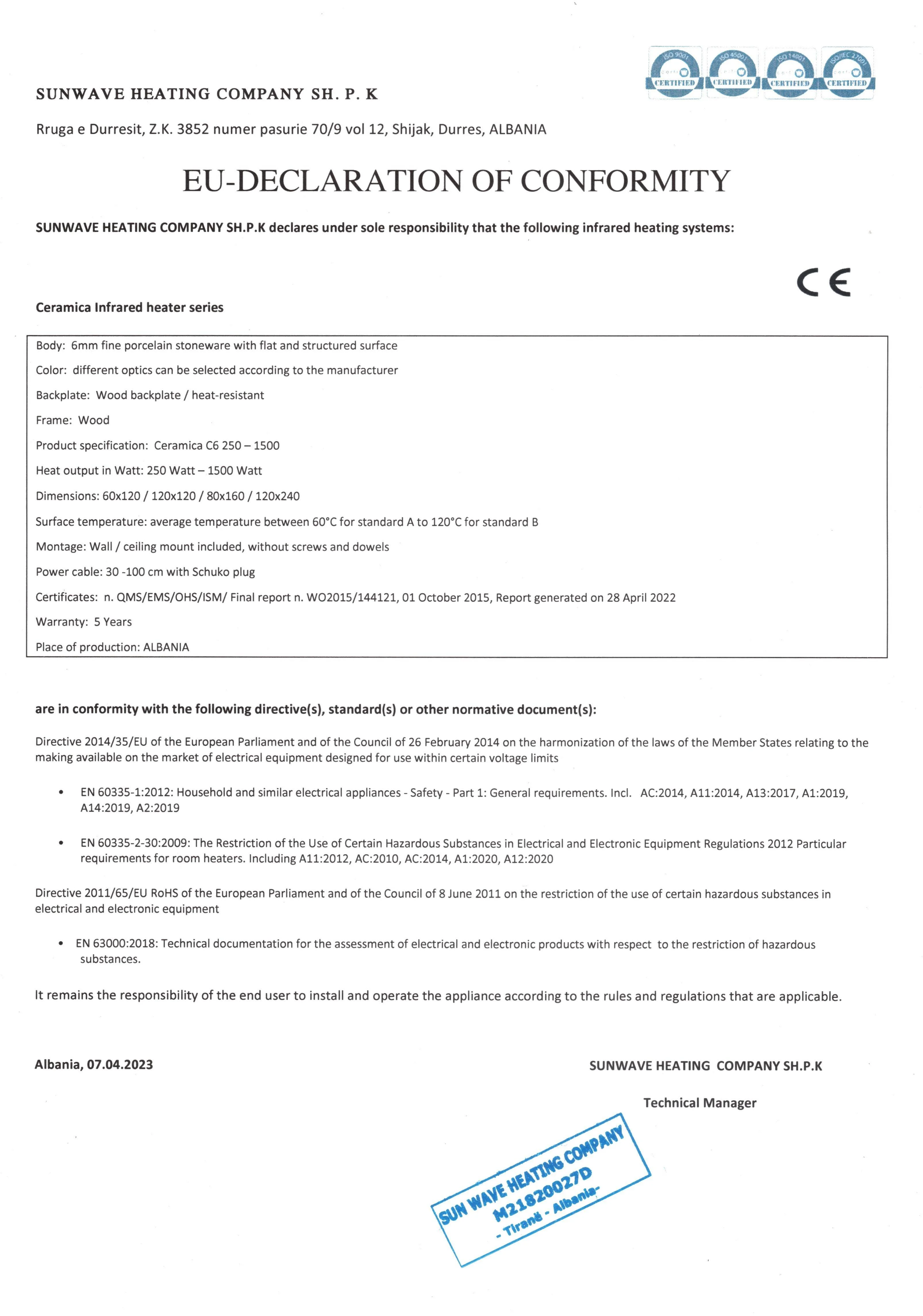
Every claim is backed by a third-party document. No self-certification. No manufacturer testing.
TU Dresden — Radiation Efficiency
IR emission at 8.52 µm wavelength confirmed. Radiation efficiency ratio fully compliant. Technische Universität Dresden, October 2022.
Fraunhofer WKI — Indoor Air Quality
Total VOC emissions of 0.043 mg/m³ — far below regulatory limits, with no formaldehyde, benzene or other carcinogenic compounds detected. Europe's leading indoor air quality institute. Full VOC spectrum tested.

Labor S.A. — Electrical Safety
Class II / IP20. Leakage current 0.1 mA (limit: 0.25 mA). Surface temp, insulation, overheating — all compliant. Report 2316.001.3.01, December 2024.
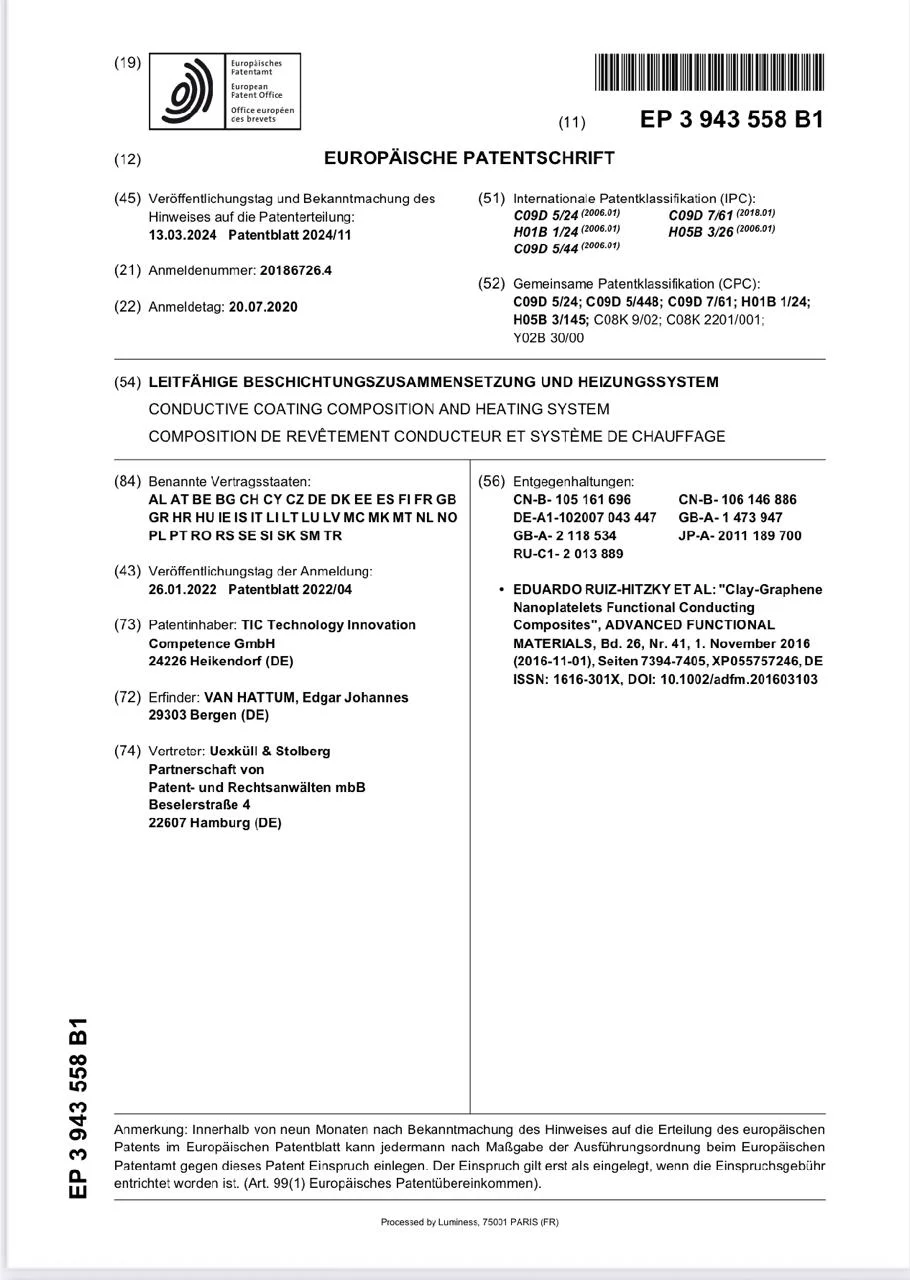
EP 3 943 558 B1 — Magnetocaloric Paste
German patent & European patent (March 2024) protecting the carbon nanotube & graphene heating paste — the heart of the technology, confirmed by TU Dresden.
Swiss Cantonal Energy Code
MuKEn 2014 requires a renewable system — typically a heat pump — when a fossil boiler reaches end-of-life. SunWave Ceramica isn't that system, but pairs naturally with one: targeted infrared for the rooms it runs cold, especially alongside solar PV.

ISO 14001 Environmental Management