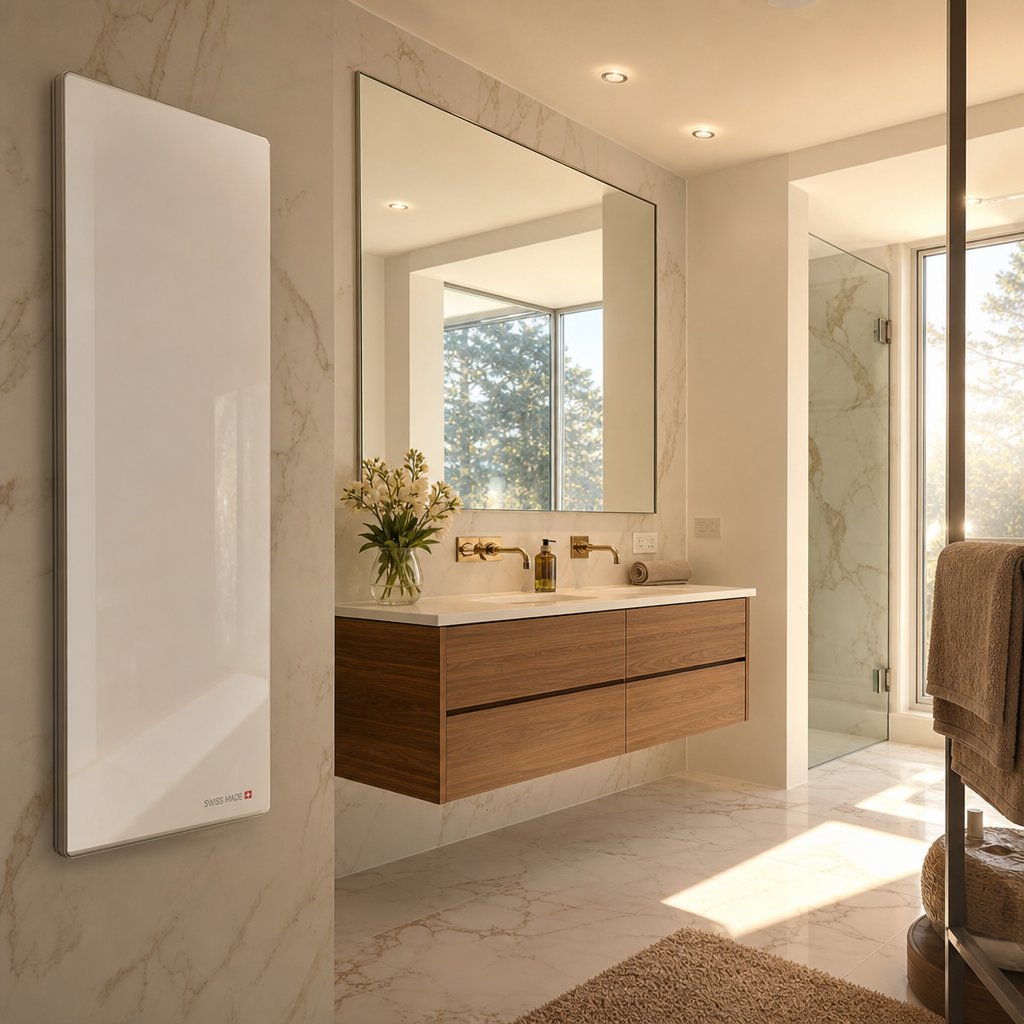
There is a room in every Swiss home where infrared heating demonstrates its advantages most clearly — not the living room, not the home office, but the bathroom. The reasons are structural: bathrooms are small (typically 4–8 m²), they demand heat fast (you step in cold and want warmth within seconds), and they carry persistent moisture — exactly the conditions that expose the weaknesses of conventional heating and play to every strength of infrared. This guide explains why the bathroom is the perfect application for infrared heating, how to position a panel safely within Swiss IP protection zones, what size panel you need, and why CHF 19 per year is a realistic running cost figure rather than a marketing claim.
Why Bathrooms Are Perfect for Infrared Heating
Four characteristics of the bathroom combine to make it the ideal infrared application. No other heating technology addresses all four simultaneously.
Small space, high heat demand. A 6 m² bathroom needs very little total wattage to reach comfort temperature — a single 350W panel is more than adequate. The investment is minimal. The impact is immediate.
Short, intense usage intervals. The bathroom is typically used twice a day for 15–30 minutes. A underfloor heating system that takes two hours to warm the screed before it radiates useful heat is structurally unsuited to this usage pattern. An infrared panel delivers perceivable warmth within the first minute of operation — and because it is surface-mounted on the wall or ceiling, there is no thermal mass to overcome. You switch it on when you need it; it heats while you are in the room.
High moisture levels. This is where infrared heating's physics become particularly relevant. Condensation — the root cause of both mirror fogging and bathroom mould — requires a cold surface. Infrared radiation heats surfaces directly; it does not merely warm the air and hope that warm air eventually warms the surfaces. In a bathroom with infrared heating, the mirror surface, the wall tiles, and the grout lines all receive direct radiant energy and remain warmer. Cold surfaces disappear. Condensation has nowhere to form.
Air quality in an enclosed space. Because bathrooms are small and often poorly ventilated, the materials from which heating equipment is made matter more here than anywhere else in the home. The Fraunhofer WKI institute independently tested SunWave Ceramica panels and measured total VOC emissions of just 0.043 mg/m³ — against a regulatory limit of 10 mg/m³, more than 230 times below the permissible threshold. No carcinogenic compounds were detected, including formaldehyde, benzene, or toluene. Full test documentation is available on the Research page.
The Science: Why Infrared Prevents Bathroom Mould
Mould is a moisture problem before it is a ventilation problem. The sequence is always the same: humid air from the shower meets a wall surface that is cold enough to be below the dew point, water vapour condenses on that surface, and mould colonises the wet substrate. In a typical Swiss bathroom — particularly in pre-1980 buildings with solid external walls that absorb cold overnight — the wall surface temperature can be several degrees lower than the air temperature. Even with the radiator running, the air warms up, but the external wall remains cold. Condensation continues.
Infrared heating interrupts this cycle at the source. The panel emits long-wave thermal radiation in the 8–10 micrometre range (TU Dresden measured SunWave Ceramica's peak wavelength at 8.52 µm, per DIN EN IEC 60675-3). This radiation travels through the air without meaningful absorption and strikes solid surfaces — including walls, tiles, and grout — where it is converted to heat. The result is that wall surface temperatures rise, not just air temperatures. When the wall is warm, the dew point of the humid post-shower air is never reached at that surface. No condensation. No mould.
This is not a theoretical claim. Users in Swiss apartments with chronic mould problems in external-wall bathrooms consistently report that mould stops recurring after infrared installation — without any additional ventilation or chemical treatment. The physics removes the precondition for growth.
Target the coldest wall. For maximum mould prevention, position the panel so it radiates directly onto the coldest surface in your bathroom — typically the exterior wall furthest from the heated living spaces. This is the surface where condensation forms first and most severely. Direct infrared radiation onto that wall raises its surface temperature above the dew point and eliminates the mould's foothold.
IP44 Safety Zones — What Is Allowed Where
Electrical installations in Swiss bathrooms are governed by IEC 60364-7-701 (implemented in Switzerland as SN 411000), which defines three protection zones based on proximity to water sources. Understanding these zones is essential for safe and legally compliant installation.
| Zone | Location | IP Requirement | SunWave Ceramica |
|---|---|---|---|
| Zone 0 | Inside bath or shower enclosure | IPX7 minimum | NOT suitable |
| Zone 1 | Directly above bath/shower (up to 2.25m height) | IPX4 minimum | NOT suitable |
| Zone 2 | Within 60cm of bath/shower edge | IPX4 minimum | NOT suitable |
| Zone 3 (outside) | >60cm from bath/shower edge | No requirement (IP44 recommended) | YES — suitable ✓ |
The SunWave Ceramica IR-PHP-D1 carries a standard IP44 rating — meaning it is protected against solid objects larger than 1mm and against water splashing from any direction. This qualifies it for installation in Zone 3 and in general bathroom areas. It is not rated for Zones 0, 1, or 2, where direct water contact is a realistic possibility.
In practical terms, Zone 3 covers the majority of a typical Swiss bathroom. The area above the toilet, beside the basin, opposite the shower on the far wall, and on the ceiling above the toilet or vanity area all fall within Zone 3 at standard bathroom dimensions. A licensed electrician must carry out or supervise the electrical connection in a bathroom, and the circuit must be protected by a 30 mA residual current device (RCD/FI-Schalter).
Bathroom Sizing and Running Costs
Bathrooms are, by the standards of infrared heating, very easy to size. They are small, compact, and often well-insulated by the surrounding structure. Tiled walls absorb heat readily and hold it well. You can plan at the lower end of the standard sizing range — 25 W/m² is often sufficient.
| Bathroom Size | Recommended Panel | Installation Cost | Annual Running Cost* |
|---|---|---|---|
| Up to 4 m² | 1 × 250W SunWave Ceramica | CHF 550 | ~CHF 14/yr |
| 6 m² (typical Swiss bath) | 1 × 350W SunWave Ceramica | CHF 550 | ~CHF 19/yr |
| 8–10 m² | 1 × 350W or 450W | CHF 550–620 | ~CHF 19–26/yr |
| 10–15 m² (large bathroom) | 2 × 350W SunWave Ceramica | CHF 1,100 | ~CHF 38/yr |
*Annual running cost calculated at 30 minutes of use per day, 365 days, CHF 0.28/kWh — the average Swiss residential electricity rate.
The CHF 19 calculation, in full
Here is the arithmetic behind the headline figure. A 6 m² Swiss bathroom, heated with one 350W SunWave Ceramica panel, used for 30 minutes per day throughout the year:
350W × 0.5 hrs/day × 365 days = 63.875 kWh/year
63.875 kWh × CHF 0.28/kWh = CHF 17.89/year (rounded to CHF 19)
For comparison: a 150W electric towel rail running 8 hours per day costs 150W × 8 hrs × 365 days × CHF 0.28 = CHF 122.64 per year — for a single modest towel rack that does not heat the room, does not warm the mirror, and does nothing to prevent mould. The infrared panel is 85% cheaper to run and delivers more than one function.
Payback comparison: Switching from a permanently-on electric towel rail (CHF 122/year) to a SunWave Ceramica infrared panel (CHF 19/year) saves CHF 103 per year. The CHF 550 panel cost (thermostat included) pays back in around 5 years on energy savings alone — before accounting for any value attributed to no longer having a fogged mirror or recurring mould problems.
Installation Tips for Swiss Bathrooms
The physical mounting is straightforward; the regulatory requirements are what demand attention. Here are the key considerations for a compliant, effective bathroom installation.
Ceiling mounting — the optimal position
For most Swiss bathrooms, ceiling mounting directly above the basin and toilet area (Zone 3) provides the best overall coverage. The panel radiates downward onto the floor, the walls, and the occupant, and because it is on the ceiling, it is categorically outside the splash zones of the shower or bath. Ensure the ceiling position is more than 60 cm horizontally from the edge of the shower enclosure to stay within Zone 3. For more on ceiling installation technique generally, see our guide on ceiling-mounted infrared heating.
Wall mounting opposite the shower
Mounting the panel high on the wall opposite the shower — facing the shower area — is particularly effective at warming the space where you step out of the shower and stand while drying. Ensure the panel centre is more than 60 cm from the shower enclosure edge. This position also provides excellent direct radiation onto the coldest exterior wall, which maximises the mould-prevention effect.
Use a humidity-sensing thermostat
A hygrostat — a thermostat that responds to relative humidity rather than temperature — is an excellent complement to bathroom infrared heating. When shower steam is detected (humidity spike), the hygrostat automatically activates the panel. This provides automatic mould prevention and means you never need to remember to switch the panel on. When humidity drops back to normal after ventilation, the panel switches off. Combined with a conventional timer thermostat set to pre-heat 15 minutes before your morning shower, you have a fully automated bathroom climate system for a few tens of Swiss francs of control hardware.
IP44 requirement
For any bathroom installation in Zone 3, IP44 is the minimum recommended rating even though it is not legally required there. The SunWave Ceramica IR-PHP-D1 meets IP44 as standard — there is no special bathroom version to order. The IP44 rating is built into every unit.
Replacing an Old Bathroom Heater
Most Swiss bathrooms are heated by one of three systems: a section of the central heating wet radiator circuit, a permanently-on electric towel rail, or a bathroom fan heater. Each has significant limitations that a single SunWave Ceramica panel addresses cleanly.
The wet-circuit radiator warms the room reasonably well but is tied to the central heating schedule — it heats when the boiler fires, not necessarily when you are in the bathroom. It does not directly warm wall surfaces, so mould remains possible. And as MuKEn 2025 regulations push Swiss homeowners away from fossil fuel boilers, a wet radiator in the bathroom becomes a liability rather than an asset.
The electric towel rail is an energy-intensive, permanently-on device that does almost nothing to heat the room. At 150W running 8 hours a day, it costs CHF 122 per year to keep towels warm — and warm towels alone do not prevent a fogged mirror or mould in the grout.
The bathroom fan heater is the worst option: it warms the air rapidly but not the surfaces, creates noise and draughts, and is typically rated at 1,000–2,000W — making it by far the most expensive heating option for a 5-minute blast of warm air.
A single SunWave Ceramica panel replaces all three functions: it heats the room, warms all surfaces including the mirror and tiles, prevents mould, and keeps towels dry — all for less than CHF 20 per year. No plumbing, no boiler dependency, no noise, no draughts.
Frequently Asked Questions
Can you use infrared heating in a bathroom?
Yes — provided the panel is IP44-rated and installed in Zone 3, more than 60 cm from the shower or bath edge. The SunWave Ceramica IR-PHP-D1 is IP44-rated as standard. The electrical connection must be made by a licensed electrician with a 30 mA RCD protecting the circuit. Within these parameters, infrared heating is fully safe and highly effective in a bathroom environment.
Does infrared heating prevent bathroom mould?
Yes, very effectively. Mould requires cold surfaces where humid air can condense. Infrared radiation heats wall surfaces directly — unlike conventional heaters that only warm the air — keeping them above the dew point and preventing condensation. The Fraunhofer WKI independently tested SunWave Ceramica materials and found total VOC emissions of just 0.043 mg/m³ (more than 230 times below the 10 mg/m³ limit), with no carcinogenic compounds detected, confirming the panel itself poses no mould or air quality risk.
How much does it cost to heat a bathroom with infrared?
Approximately CHF 19 per year for a typical 6 m² Swiss bathroom using 30 minutes of heating per day. The full calculation: 350W × 0.5 hrs/day × 365 days × CHF 0.28/kWh = CHF 17.89/year. Even at 45 minutes of daily use the cost stays below CHF 27. A permanently-running electric towel rail (150W, 8 hrs/day) costs CHF 122/year — making infrared roughly 85% cheaper in this application.
What size infrared panel do I need for my bathroom?
A 250W panel suits bathrooms up to 4 m². A 350W panel is the right choice for the most common Swiss bathroom size of 6–8 m². For bathrooms of 8–10 m², a 350–450W panel covers the space comfortably. An IP44 protection rating is required for all bathroom installations — the SunWave Ceramica IR-PHP-D1 carries IP44 as standard, so no special selection is needed.
Transform your bathroom heating for CHF 550
One SunWave Ceramica panel. No plumbing. No mould. No fogged mirror. Bathroom-ready with IP44 rating as standard. Ships across Switzerland in 5–7 working days. Free installation consultation included.
View SunWave Ceramica →