Infrared Heating for Solar Installers
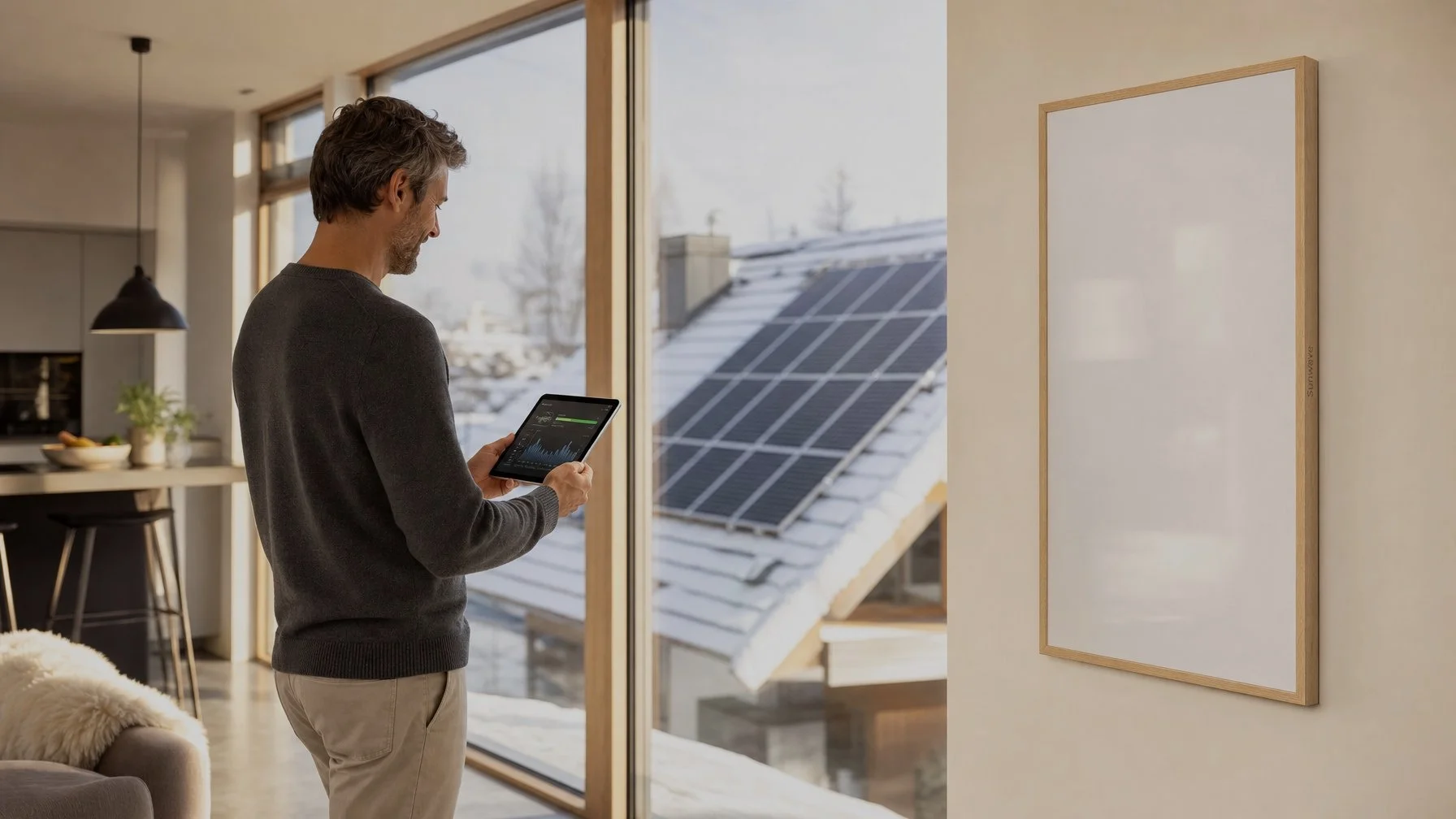
Infrared heating and rooftop solar are the natural pair in Swiss residential energy. Add SunWave Ceramica to every PV project and give your clients 100% renewable heating — self-consumed, not fed back to the grid.
Become a Reseller PartnerWhy Solar + Infrared Is the Best Swiss Energy Package
Most solar installers focus on grid feed-in or battery storage. Infrared heating is a third option — and often the most financially attractive for your clients. Read more in why Swiss solar installers are adding infrared heating to every PV proposal.
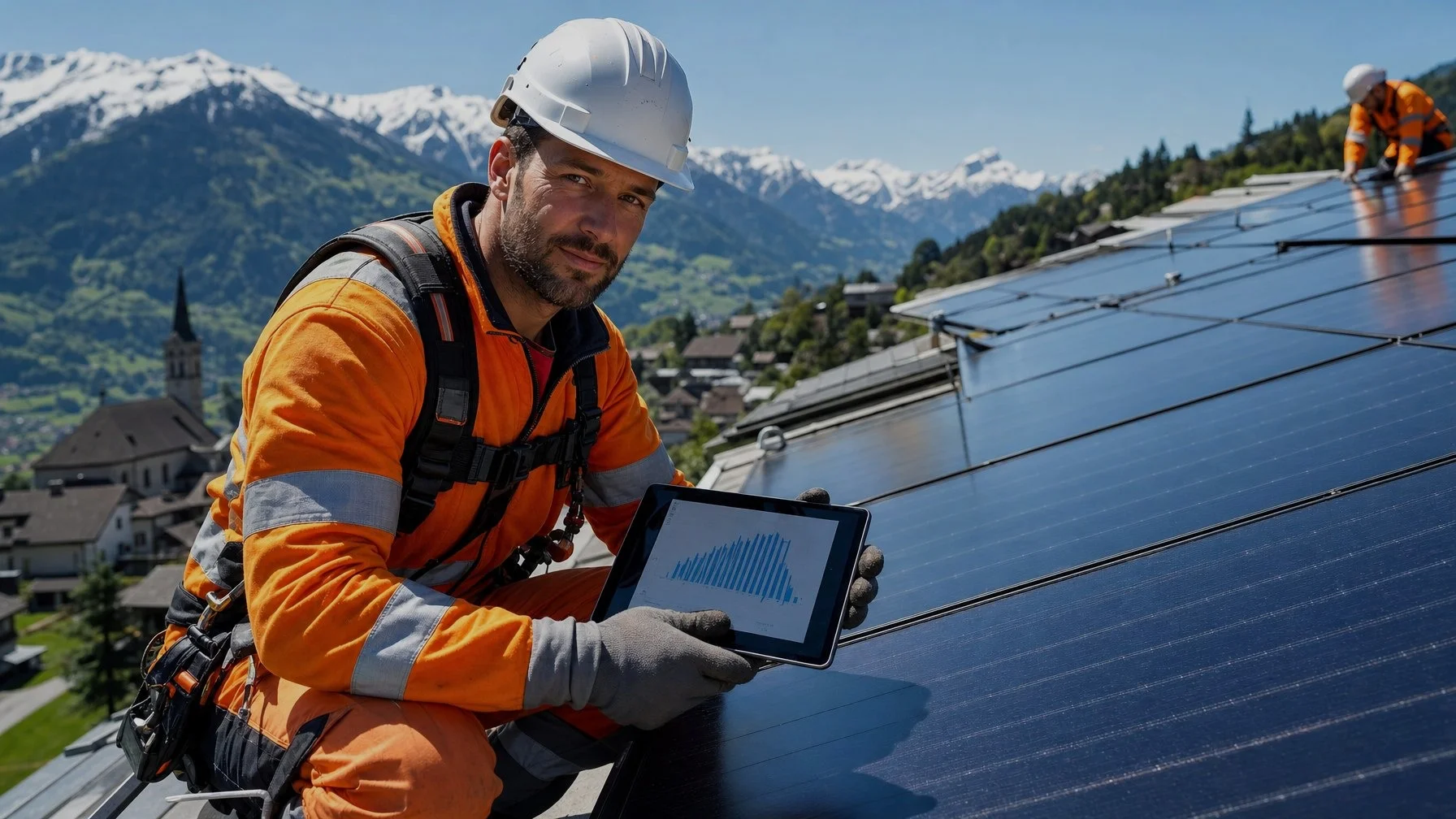
A 400 W rooftop solar panel produces approximately 400 Wh per hour in good Swiss sunlight conditions. A SunWave Ceramica draws exactly 650 W. That means two solar panels fully power one heating panel — and in a typical 80 m² apartment requiring three panels, a 6 kWp rooftop installation (common for Swiss residential) produces more than enough energy to run the heating system during solar hours.
The thermal mass advantage
Unlike battery storage, thermal mass is free. When a SunWave Ceramica runs during peak solar generation (11:00–15:00), it heats walls, floors, and furniture — not just air. That stored warmth radiates back into the room for hours after the panel is switched off. A 2-hour solar heating session can maintain comfortable temperatures for 4–6 hours in a well-insulated space.
This means solar customers don't need expensive battery systems to get overnight warmth from daytime solar generation — the thermal mass does it for free.
A natural add-on for heat-pump renovations
Many of your solar clients are also dealing with Switzerland's MuKEn 2014 requirements — cantons increasingly require a renewable system, typically a heat pump, when a gas or oil boiler reaches end-of-life. SunWave Ceramica isn't a replacement for that primary system, but it's a natural addition during the same renovation: targeted infrared panels for the rooms the new system runs cold, powered by the same rooftop solar.
What your clients get
- 100% renewable heating when solar is producing — self-consumed, not exported
- Zero maintenance — no moving parts, no service contracts, ever
- 0.043 mg/m³ TVOC — independently tested by Fraunhofer WKI
- Pairs naturally with heat-pump renovations — infrared handles the rooms the main system runs cold
- 5-year manufacturer warranty per panel
- One supplier relationship for both generation and supplemental heating
Example: 80m² Apartment with 6kWp Solar
Energy Flow
Solar Installer Partner Programme
Add SunWave Ceramica to your installation packages. Co-branded marketing materials, technical support, and dedicated account management.
Partner Pricing
We offer dedicated pricing for solar installers and trade partners. Contact us to discuss your project volume and we'll provide a tailored quote.
- Co-branded quote templates with your company name and logo
- Technical product training — one session covers everything your team needs
- Pre-sales support: we'll help calculate savings for your specific client's project
- Dedicated Switzerland installer directory listing (in development)
- All 3 independent test reports (Fraunhofer WKI, TU Dresden, Labor S.A.) available for your client presentations
- Priority stock allocation during peak heating season (Oct–Mar)
- 5-year warranty managed directly — no returns admin for your team
Technical Notes for Installers
Everything your installation team needs to know about integrating SunWave Ceramica with solar PV systems.
Load profile and sizing
Each SunWave Ceramica draws 650 W at 230 V AC (3.04 A). Panels are resistive loads — power factor is 1.0. There is no startup surge. For circuit sizing, treat each panel as a continuous 650 W load and size the circuit cable and breaker accordingly (typically 10 A breaker for 1–2 panels).
Thermostat integration for solar optimisation
For solar-optimised operation, install a smart thermostat with schedule and cloud connectivity. Programme the thermostat to pre-heat during the solar generation window (typically 10:00–16:00 in Switzerland). Set a higher setpoint during solar hours and a lower setpoint (or off) during evening grid-import hours. This maximises the thermal mass benefit and minimises grid consumption.
A full smart home integration with a solar inverter API (SMA, Fronius, SolarEdge all have open APIs) can automate this completely — turning panels on when solar export exceeds a threshold and off when generation drops below consumption.
Circuit requirements
- 230 V AC single-phase — standard Swiss supply
- Class II (no earth required) — but earth connection is permitted
- Standard T13 plug (plug-in) or hardwired to fused spur
- No special cabling beyond normal lighting/socket cable (if ≤2 panels per circuit)
- Minimum 3-core 1.5 mm² cable for runs up to 20 m
Installation time
A trained installer can mount and wire a single panel in approximately 45–60 minutes, including wall anchoring, cable dressing, and thermostat wiring. A 3-panel installation (80 m² apartment) typically takes 2.5–3 hours on site including thermostat programming.
Solar Self-Consumption Calculation
Add infrared heating to your solar package today
Contact us to discuss partner terms, technical questions, or to request a sample panel for your showroom.
Contact Us