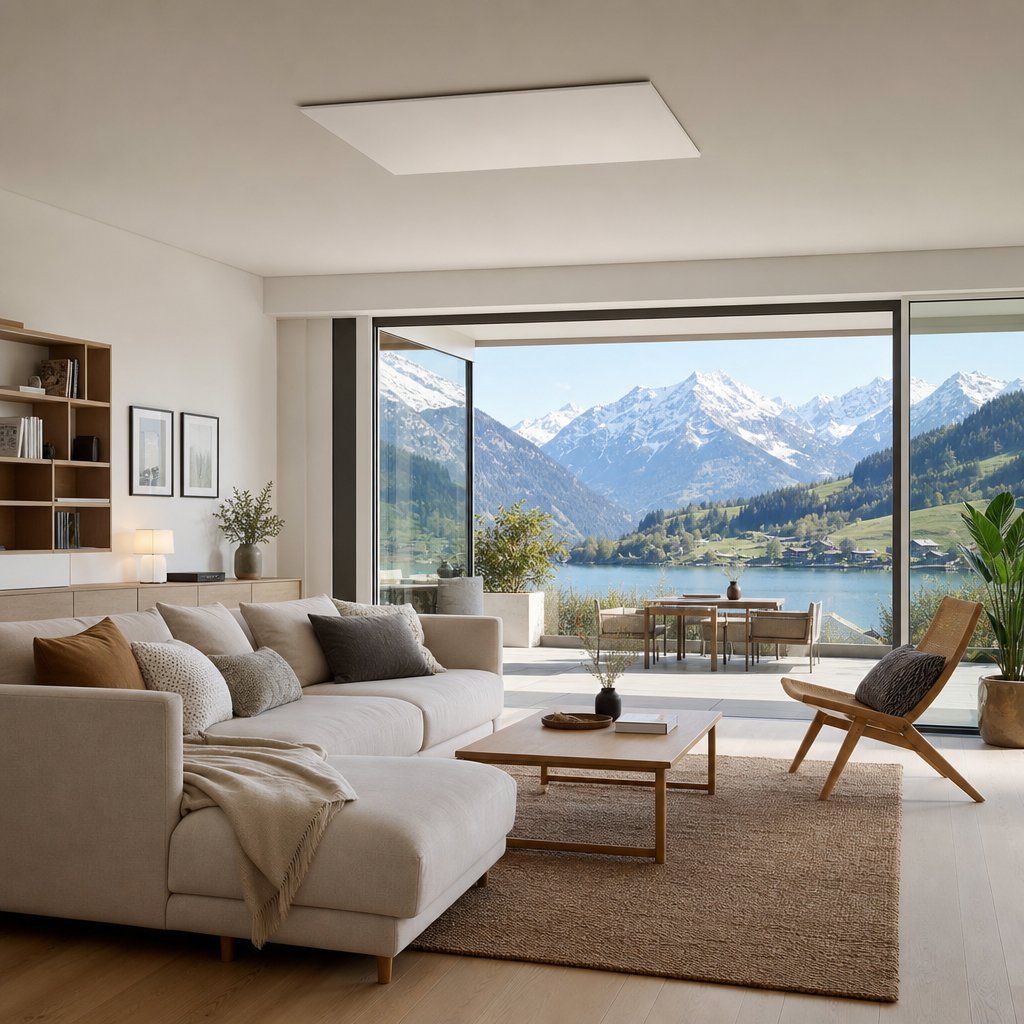
Most people fit infrared panels where conventional radiators used to hang — on the wall at shoulder height. It feels familiar. But once you understand how infrared radiation actually moves through a room, a different conclusion becomes unavoidable: in the majority of spaces, the ceiling is the superior mounting position. A panel radiating downward from overhead covers the entire floor area with no dead zones, warms every surface in the room uniformly, and does so with the same effortless quality as winter sunshine. This guide explains the physics, walks through the installation process step by step, and gives you the sizing numbers you need to plan a ceiling-mounted infrared heating system for any Swiss property.
Why Ceiling Mounting Is Physically Superior
Infrared radiation travels in straight lines from its source to the surfaces it strikes. Unlike a convective heater, which warms the air and relies on that air circulating to reach people and objects, an infrared panel delivers energy directly to every surface it can "see." The mounting position determines how much of the room falls within that line of sight.
A wall-mounted panel has a radiation angle of approximately 120 degrees — it illuminates a broad cone in front of it, but the area behind and to the sides remains in the panel's shadow. Depending on room geometry and furniture placement, meaningful parts of the floor area may receive very little direct radiation. A ceiling-mounted panel, by contrast, faces directly downward. Its surface normal points straight into the room, maximising effective irradiance on every occupant and object below. The radiation spreads outward in a full 180-degree hemisphere — every square metre of floor, every wall face, every piece of furniture, every person in the room is within direct line of sight.
There is a secondary benefit that is often overlooked: gravity-assisted convection. The small amount of warm air that does rise from heated surfaces rises toward the ceiling — where the panel itself is located. This gentle convective layer adds a supplementary warming effect that reinforces rather than fights the radiant heat distribution.
It is also worth noting that TU Dresden's independent testing of the SunWave Ceramica panel — measuring radiation efficiency and a peak emission wavelength of 8.52 µm under DIN EN IEC 60675-3 — was conducted with a ceiling-mounted installation. The test conditions reflect real-world ceiling use, making those results directly applicable to the installation configuration described in this guide.
Finally, there are the practical advantages that come at no thermodynamic cost: ceiling mounting uses no floor space, cannot be blocked by furniture, and produces a clean, unobtrusive finish that is particularly appropriate for modern Swiss interiors where visible radiators and wall appliances are unwelcome.
Ceiling vs Wall: Direct Comparison
Both mounting options have legitimate applications. The table below structures the key differences to help you decide which is right for each room.
| Factor | Ceiling Mount | Wall Mount |
|---|---|---|
| Coverage angle | 180° (full hemisphere) | ~120° (limited by wall angle) |
| Floor space used | None | None |
| Furniture blocking radiation | Impossible | Possible if furniture placed in front |
| Visual appearance | Clean / nearly invisible | More visible |
| Ideal room types | Living rooms, bedrooms, offices | Bathrooms, corridors, spot heating |
| Installation complexity | Slightly more complex | Simpler |
For rooms where wall surfaces are fully occupied by windows, built-in wardrobes, or kitchen units — which is common in Swiss apartments and renovated farmhouses — the ceiling is often the only viable mounting surface. In open-plan living spaces, a ceiling panel positioned at the geometric centre of the room provides the most even distribution and the most natural sense of warmth.
Panel Sizing Guide for Swiss Rooms
The fundamental sizing rule for infrared heating in Switzerland is straightforward: plan for 25–35 watts per square metre in well-insulated buildings (modern construction, triple glazing, façade insulation), and 35–50 W/m² in buildings with average or below-average insulation (pre-1990 construction without subsequent renovation).
Ceiling height is a secondary factor. Standard Swiss room heights of 2.4 m work well with the figures below. For rooms with ceilings above 2.6 m, add approximately 10–15% to the recommended wattage to account for the increased volume and the slightly longer radiation path to floor level.
| Room Size | Ceiling Height | Recommended Power | SunWave Panels | Estimated Cost |
|---|---|---|---|---|
| Up to 10 m² | Standard 2.4m | 250–350 W | 1 × 350W | CHF 550 |
| 10–15 m² | Standard 2.4m | 350–500 W | 1–2 panels | CHF 550–1,100 |
| 15–25 m² | Standard 2.4m | 500–750 W | 2 panels | CHF 1,100 |
| 25–35 m² | Standard 2.4m | 750–1,000 W | 2–3 panels | CHF 1,100–1,650 |
| 35–50 m² | 2.6m+ | 1,000–1,500 W | 3–4 panels | CHF 1,650–2,200 |
| Full home 100 m² | Various | 2,500–3,500 W | 7–8 panels | CHF 3,850–4,400 |
Rule of thumb: 25–35 W/m² for well-insulated Swiss buildings; 35–50 W/m² for older buildings with average insulation. When in doubt, round up — panels controlled by a thermostat will run less frequently in milder conditions and won't waste energy simply because they have capacity to spare.
These figures assume the panels are the primary heat source for the room and are controlled by a room thermostat. If you are using ceiling panels as supplementary heat in a room already partially served by underfloor heating or a central system, you can work at the lower end of the range.
Step-by-Step Ceiling Installation
Ceiling installation of a SunWave Ceramica panel is less complex than most people anticipate. The mechanical work requires only basic tools; the only task that legally requires a professional in Switzerland is the electrical connection to a hardwired circuit.
Step 1: Mark the panel position
Mark the intended centre of the panel on the ceiling. Leave a clearance of at least 30 cm from all walls to ensure even heat distribution across the room. In a rectangular room, positioning the panel at the geometric centre provides the best overall coverage. For long, narrow rooms, consider two panels spaced along the room's length rather than a single central panel.
Step 2: Locate ceiling joists or prepare fixings
In timber-frame or wood-joist ceilings, use a stud finder to locate the structural members beneath the plasterboard. Always fix the mounting bracket directly into structural timber — never into plasterboard alone. In solid concrete ceilings (common in Swiss multi-family buildings), use appropriate concrete anchors rated for dynamic loads of at least 50 kg.
Step 3: Attach the mounting bracket
The SunWave Ceramica panel is supplied with a purpose-designed mounting bracket. Fix it to the ceiling using two screws with standard M6 fixings. The bracket is designed for a flush installation with minimal protrusion from the ceiling surface. Verify with a spirit level before fully tightening.
Step 4: Hang the panel
The panel engages with the bracket via a snap-lock system. One person can complete this step without assistance. Once seated, the panel hangs securely and cannot disengage accidentally. Run the connection cable neatly along the ceiling surface toward the power source — use a surface-mount cable trunking for a clean finish, or route the cable inside the ceiling void if access is available.
Step 5: Connect to power
SunWave Ceramica panels operate on standard 230V single-phase power. There are two connection options. A plug-in connection to a ceiling socket or electrified track requires no electrician licence and is appropriate for rooms where a suitable socket is already in position. A hardwired connection directly to a 230V circuit — the neater, more permanent option — must be carried out by a licensed electrician under Swiss low-voltage installation regulations (NIV). For bathroom installations, a licensed electrician is required regardless of connection method, and the circuit must be protected by a 30 mA residual current device (RCD).
Step 6: Set the thermostat
SunWave Ceramica panels are compatible with all standard 230V thermostats — smart, programmable, or manual. Mount the thermostat at seated head height on an interior wall, away from direct radiation from the panel. A programmable thermostat with time-based setback scheduling will significantly reduce energy consumption by avoiding heating empty rooms. Smart thermostats compatible with KNX, Matter, or standard Wi-Fi protocols can be integrated into a whole-home automation system for multi-zone control.
Ceiling Mounting in Specific Swiss Room Types
Living room
For a standard Swiss open-plan living and dining area of 30 m², two SunWave 350W panels positioned symmetrically along the room's central axis provide optimal coverage. Mount at the geometric centre of each half of the room rather than clustering both panels together. The radiant quality of ceiling-mounted infrared heating is particularly noticeable in living rooms: occupants on the sofa describe the experience as similar to sitting in winter sunshine — warm, without the stuffiness that forced-air or radiator systems create.
Bedroom
Position the panel above the sleeping area rather than at the geometric centre of the room. A bedroom is primarily used for sleeping — the area above the bed is where the radiant comfort matters most. Consider a lower-wattage panel (250W) for bedrooms, or use a programmable thermostat to run the panel at reduced output during sleeping hours. The absence of air movement — infrared heating creates no convective draughts — makes it particularly well-suited to bedroom use.
Home office
Mount the panel directly above the desk area for concentrated zone heating of the workspace. Rather than heating the entire room to full comfort temperature, a single panel above the desk can maintain a comfortable working environment while the rest of the room runs at a reduced background temperature. A 650 W panel run for a typical working day (4–6 hours) costs roughly CHF 22–34 per month — a modest, predictable cost for heating only the space you're actually using.
Bathroom
The SunWave Ceramica IR-PHP-D1 carries an IP44 moisture protection rating, making it suitable for bathroom installation in Zone 3 — defined as more than 60 cm from the edge of the shower or bath enclosure. Do not install in Zone 0 (inside the shower or bath) or Zone 1 (directly above the bath or shower up to 2.25 m height). For Zone 2 (within 60 cm of the shower), IP44 is the minimum rating required, but professional advice on exact placement is strongly recommended. For the complete bathroom-specific installation guide, see our article on infrared heating in the bathroom.
Costs and Return on Investment
Ceiling installation of infrared heating involves two cost elements: the panels themselves, and the electrical installation work. There are no ongoing maintenance costs — the SunWave Ceramica panel has no moving parts, no combustion process, no filter, and no annual service requirement.
| Cost Element | Details | Amount |
|---|---|---|
| Panels (7–8 for 100 m² home) | SunWave Ceramica at CHF 550 each, thermostat included | CHF 3,850–4,400 |
| Electrician (installation) | Wiring, fixings, thermostat connection | CHF 400–800 |
| Total installation | Complete system, 100 m² | CHF 4,250–5,200 |
| Running cost per panel | 650 W, ~4–6 hrs/day at CHF 0.28/kWh | CHF 22–34/month |
| Maintenance | No moving parts, no service required | CHF 0 |
Running costs scale with how many panels you actually run and for how long — a single ceiling-mounted panel used for zone heating in an office or bedroom costs CHF 22–34 per month, while a full 7–8 panel system used across a heating season costs proportionally more. There are no boiler replacement costs, no annual servicing contracts, and the panels carry a 5-year warranty backed by a 30+ year design life.
For a detailed cost comparison between infrared and other heating technologies, including heat pumps and pellet boilers, see our complete infrared heating guide for Switzerland.
No maintenance costs, ever. The SunWave Ceramica panel contains no moving parts, no combustion components, and no circulating fluid. There is nothing to service, nothing to clean, and nothing to replace before the end of its 30+ year design life. Factor this into your cost comparison — a gas boiler costs CHF 300–500 per year in maintenance alone.
Frequently Asked Questions
Can infrared panels be mounted on the ceiling?
Yes — and the ceiling is actually the optimal mounting position. A ceiling-mounted panel radiates downward across a full 180-degree hemisphere, providing even coverage of the entire room with no dead zones. Furniture cannot block the radiation path, and the clean overhead installation is visually unobtrusive. TU Dresden's independent testing of the SunWave Ceramica panel's radiation performance was conducted in a ceiling-mounted configuration.
How many infrared panels do I need for my room?
The standard rule is 25–35 W/m² for well-insulated Swiss buildings, or 35–50 W/m² for older buildings with average insulation. In practice: one SunWave 350W panel covers up to 15 m², two panels cover up to 35 m², and a complete 100 m² home requires 7–8 panels. For rooms with ceilings above 2.6 m, add approximately 10–15% to the recommended wattage.
Do I need an electrician to install ceiling infrared heating?
For a plug-in connection to an existing 230V ceiling socket, no electrician licence is required — the installation is as straightforward as hanging a light fitting. For a hardwired connection directly to a circuit in the consumer unit, Swiss NIV regulations require a licensed electrician. Bathroom installations always require a licensed electrician, plus a 30 mA RCD on the circuit, regardless of connection method.
Find the right panel for your ceiling
SunWave Ceramica IR-PHP-D1 — IP44 rated, ceiling-ready, 5-year warranty. From CHF 550 incl. thermostat. Ships to all Swiss cantons in 5–7 working days. Free consultation on sizing and installation included.
View SunWave Ceramica →