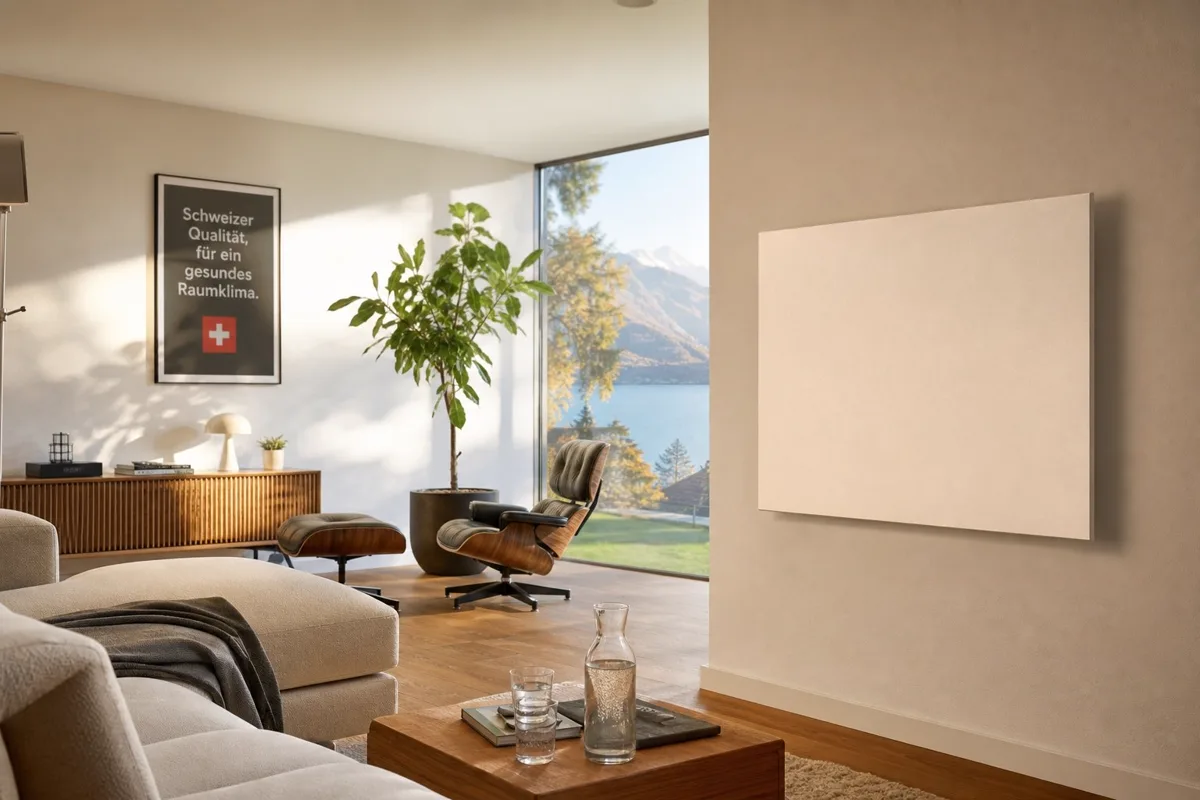
Mould on exterior walls, in room corners, or behind furniture is one of the most common problems in Swiss homes — especially in older buildings with uninsulated walls or thermal bridges. Online, you'll find plenty of claims that infrared heating "reliably prevents" mould. The truth is more nuanced: radiant heat can make a measurable contribution, but it's not a substitute for proper ventilation and fixing structural causes. This article explains the underlying building physics and shows where infrared heating genuinely helps — and where it doesn't.
How does mould actually form on walls?
Mould spores are present in virtually all indoor air — their presence isn't a sign of an "unclean" home. The problem starts when they land on a surface with enough moisture. Mould growth is favoured when the relative humidity directly at a surface stays above roughly 80% for extended periods.
This high humidity typically occurs where the surface temperature is noticeably colder than the room air temperature — for example on exterior walls, in room corners, behind cupboards placed against exterior walls, or at thermal bridges such as concrete lintels and window heads. Warm room air carrying moisture from cooking, showering, drying laundry, or simply breathing meets this cold surface and cools down there. Cold air can hold less moisture than warm air — the excess moisture condenses on the surface, or at minimum drastically raises the relative humidity right at that surface.
The Swiss standard SIA 180 ("Thermal and moisture protection in buildings") sets surface temperature requirements for exactly this reason: building elements should be insulated so that their interior-facing surface temperature doesn't drop into a critical range under normal usage conditions.
Why radiant heat addresses this problem directly
Classic convection heaters (radiators, fan-assisted electric heaters) primarily warm the air in a room. This warm air circulates and transfers some of its heat to surfaces — but cold exterior walls often remain noticeably cooler than the room air, especially if poorly insulated. The condensation risk stays high right at these spots, even when the perceived room temperature feels comfortable.
Infrared panels work differently: they emit a large share of their energy as radiant heat, which is absorbed directly by surfaces in the room — walls, floors, furniture — independent of the air temperature in between. A panel aimed at a cool exterior wall or a corner with a thermal bridge raises the surface temperature exactly where the condensation risk is highest. TU Dresden measured the SunWave Ceramica at an operating temperature of around 67°C — this energy is emitted as radiation to the surfaces within its field of view.
Radiant heat vs. convection heating: effect on cold wall surfaces
| Aspect | Convection heating | Infrared radiant heating |
|---|---|---|
| Primary heat transfer | warming room air | direct warming of surfaces |
| Effect on cold exterior walls | indirect, depends on air circulation | direct, if panel is aimed at the wall |
| Effect on surface temperature at thermal bridges | minimal | noticeable, with targeted placement |
| Air circulation / dust movement | higher (convection currents) | lower |
| Replaces ventilation? | no | no |
Important — not a miracle fix: infrared heating doesn't change a building's underlying physics. It can raise the surface temperature within its radiant field and thereby reduce the local condensation risk — but it doesn't fix existing water damage, leaking façades, rising damp, or fundamentally inadequate insulation. If mould is already visible and has a structural cause, that cause needs to be professionally addressed first.
Practical placement tips
If mould prevention is a goal, panel positioning matters:
- Aim at critical surfaces: a panel directed at a known cold exterior wall or corner specifically raises that surface's temperature.
- Keep furniture away from exterior walls: cupboards placed directly against exterior walls block both air circulation and radiant heat — a common mould hotspot regardless of heating system.
- Regular brief ventilation: 2–3 short bursts of cross-ventilation per day to remove accumulated moisture from indoor air, especially after showering and cooking.
- Steady baseline heat rather than large swings: a WiFi thermostat (included with the SunWave Ceramica) allows a consistent baseline temperature even in lightly used rooms, reducing surface temperature fluctuations.
When infrared heating alone isn't enough
In the following situations, infrared heating is not a substitute for proper remediation:
- Visible mould over large areas or recurring despite correct ventilation habits
- Water damage from leaking pipes, roofs, or façades
- Rising damp from the ground (typical in older basements and ground floors)
- A severely inadequate building envelope where surface temperature stays in the critical range despite heating
In such cases, the structural cause should first be assessed by professionals. Infrared heating can then be part of a broader solution — for example, combined with improved insulation. For more on the realistic limits of infrared heating, see our article Infrared Heating Pros and Cons: The Honest Limits.
Bottom line: infrared heating directly warms surfaces through radiation and can thereby reduce the condensation risk on cold wall surfaces — a real, physically grounded advantage over pure convection heating. It is not, however, a substitute for ventilation or for fixing structural moisture problems.
Frequently Asked Questions
Does infrared heating help against mould?
Infrared heating can contribute to mould prevention by directly warming wall surfaces through radiation, raising their temperature above the critical dew point — the main cause of condensation and mould on cold walls. However, infrared heating is not a standalone solution: adequate ventilation and fixing structural moisture problems (e.g. leaking building elements, rising damp) remain necessary in any case.
Why does mould form on walls in the first place?
Mould growth is favoured when the relative humidity at a surface stays above roughly 80% for extended periods. This typically happens at cold spots such as exterior walls, thermal bridges, or room corners, where the surface temperature is noticeably lower than the room air temperature. When warm, moisture-laden room air meets a cold surface, that moisture condenses there — an ideal environment for mould spores, which are present in virtually all indoor air.
Why is radiant heat better than convection heating for cold walls?
Convection heaters (such as classic radiators) primarily warm the air in a room, which cools again at cold wall surfaces and releases its moisture there more readily. Infrared panels heat surfaces directly through radiation — including walls they are aimed at. A warmer wall surface means lower relative humidity at that specific surface, which reduces the risk of condensation.
Does infrared heating replace ventilation against mould?
No. Regular ventilation remains essential to remove moisture from indoor air, regardless of the heating system. Infrared heating reduces the risk of condensation on cold surfaces but does not replace air exchange. For existing mould problems with a structural cause (e.g. water damage, leaking façades), the underlying building issue must be fixed first.
Targeted radiant heat for critical wall surfaces
The SunWave Ceramica can be flexibly positioned to target cold exterior walls and thermal bridges. 650W output, 6mm porcelain stoneware, WiFi thermostat, independently tested by TU Dresden, Fraunhofer WKI and Labor S.A. From CHF 550, 5-year warranty.
View the SunWave Ceramica Panel →