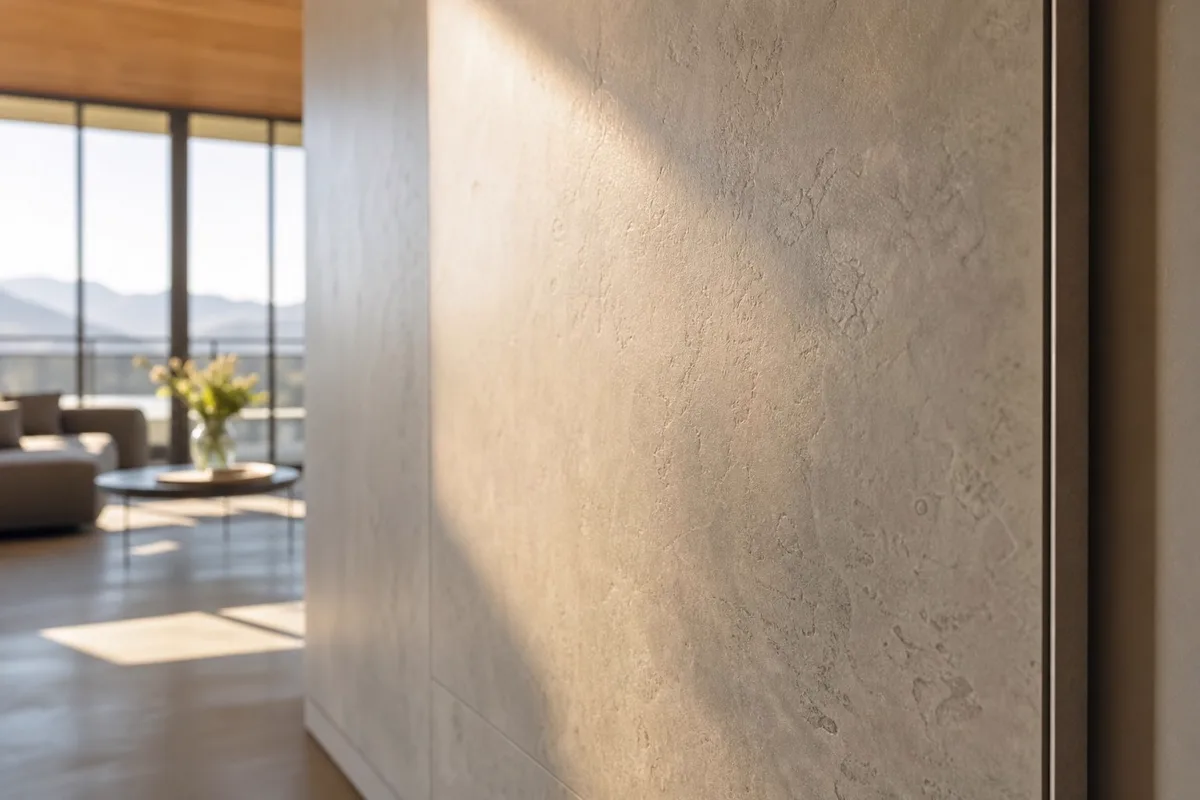
Look at most infrared panels on the Swiss market and you'll notice a pattern: painted aluminium or glass surfaces. The SunWave Ceramica instead uses a 6mm porcelain stoneware plate — the same material family used for premium floor and wall tiles. This article explains what porcelain stoneware is, why SunWave chose it, and what independent measurements from Fraunhofer WKI and TU Dresden show about this material.
What exactly is porcelain stoneware?
Porcelain stoneware (often called "gres porcellanato" using the Italian term, or "fine porcelain stoneware" in technical specifications) is a ceramic material made from finely processed clay and mineral raw materials, fired at temperatures above 1,200°C. This high-temperature firing compacts the material almost completely: water absorption is typically under 0.5%, which makes porcelain stoneware extremely resistant to frost, moisture, staining and mechanical wear. That's why it's the preferred material for heavily used floor and wall surfaces — from train station concourses to kitchen worktops.
For the SunWave Ceramica, this means the visible surface of the panel isn't a coating — it's a continuous 6mm ceramic plate. There's no paint to chip off, no powder coating that could off-gas under heat, and no fragile glass surface that could shatter on a hard impact.
Porcelain stoneware vs. aluminium and glass
The three most common surface materials for infrared panels differ significantly in construction, feel and long-term behaviour:
| Property | Aluminium (painted) | Glass (toughened, printed) | Porcelain stoneware (SunWave) |
|---|---|---|---|
| Surface treatment | powder coating / paint required | screen print / film coating possible | no coating required |
| Scratch resistance | low to medium (coating can chip) | high, but impact-sensitive | very high |
| Impact behaviour | can dent | can shatter | hard, breakage-resistant in normal use |
| Chemical resistance | depends on coating | high (surface), print can age | very high (inert) |
| Independently tested VOC levels | rarely published | rarely published | 0.043 mg/m³ (Fraunhofer WKI) |
| Weight | very light | medium | medium |
Worth knowing: no surface material makes an electric heating panel fundamentally more efficient — the conversion of electricity to heat stays close to 1:1, regardless of the surface material. The difference lies in durability, indoor air quality and the radiant character of the surface, not in a different underlying physics.
Design options: more than just a stone look
One advantage of porcelain stoneware as a substrate: it can be digitally printed and produced in virtually any finish — from neutral, light stone looks to custom patterns. This lets a SunWave Ceramica panel blend visually into living rooms, offices or hotel rooms without looking like a conventional "heater". Available design variants and dimensions are listed on our product page.
Heat radiation: why the surface matters for the physics
A heating panel's surface characteristics affect its emissivity — how efficiently a surface radiates thermal energy as infrared. TU Dresden measured the SunWave Ceramica under operating conditions: at a surface temperature of around 67°C, Wien's displacement law gives a peak radiation wavelength of 8.52 µm (measured per DIN EN IEC 60675-3). This value falls within the long-wave (far) infrared range, which is absorbed particularly efficiently by water molecules in air, skin and tissue — the physical reason radiant heat from infrared panels feels immediately warm, similar to sunlight.
For more on the heating element beneath the porcelain surface — including the patented magneto-caloric element (EP 3 123 483 B1) — see our article Magneto-Caloric Infrared Heating: The Technology Behind SunWave Ceramica.
Durability and care in everyday use
Because the surface carries no paint or coating, there's nothing to chip, yellow or scratch the way painted metal surfaces can under normal use. Cleaning follows the same routine as porcelain tile: a damp cloth, no aggressive solvents. The SunWave Ceramica ships with a 5-year warranty, including a WiFi thermostat and 650W output, starting at CHF 550.
For more on the independent test reports — including the safety measurements from Labor S.A. (EN 60335-2-30) — visit our research page.
Frequently Asked Questions
What is porcelain stoneware and why is it used for infrared panels?
Porcelain stoneware is a dense ceramic material fired at temperatures above 1,200°C from finely processed clay and mineral raw materials. It is best known from premium floor and wall tiles, valued for its very low water absorption (under 0.5%), scratch resistance, dimensional stability and chemical inertness. The SunWave Ceramica uses a 6mm porcelain stoneware plate as its radiating surface — a material that withstands sustained high temperatures without warping, discolouring or off-gassing.
Is porcelain stoneware better than aluminium or glass for infrared panels?
Each material has trade-offs. Aluminium and glass panels are often lighter and available in very slim profiles, but typically require paint or powder coatings that can off-gas at operating temperature. Porcelain stoneware needs no such coating, is more scratch-resistant than coated aluminium, and is chemically more stable than many screen-printed glass surfaces. Fraunhofer WKI measured total VOC emissions of just 0.043 mg/m³ for the SunWave Ceramica at operating temperature, with no detectable carcinogenic compounds.
Does the porcelain surface affect the panel's heat radiation?
Yes — surface characteristics affect emissivity, and therefore how efficiently a surface radiates thermal energy as infrared. TU Dresden measured the SunWave Ceramica at an operating temperature of around 67°C, resulting in a peak radiation wavelength of 8.52 µm per DIN EN IEC 60675-3 — a value in the long-wave infrared range that is absorbed particularly efficiently by water molecules in air, skin and tissue.
What design options exist for SunWave porcelain panels?
Porcelain stoneware can be produced in a wide range of surface finishes, from neutral stone-look designs to custom patterns. SunWave offers several design variants suitable for residential, office and hospitality environments. Details on available variants are on our product page.
Experience the porcelain surface of the SunWave Ceramica
650W output, 6mm porcelain stoneware, patented magneto-caloric heating element (EP 3 123 483 B1), independently tested by TU Dresden, Fraunhofer WKI and Labor S.A. From CHF 550, 5-year warranty.
View the SunWave Ceramica Panel →