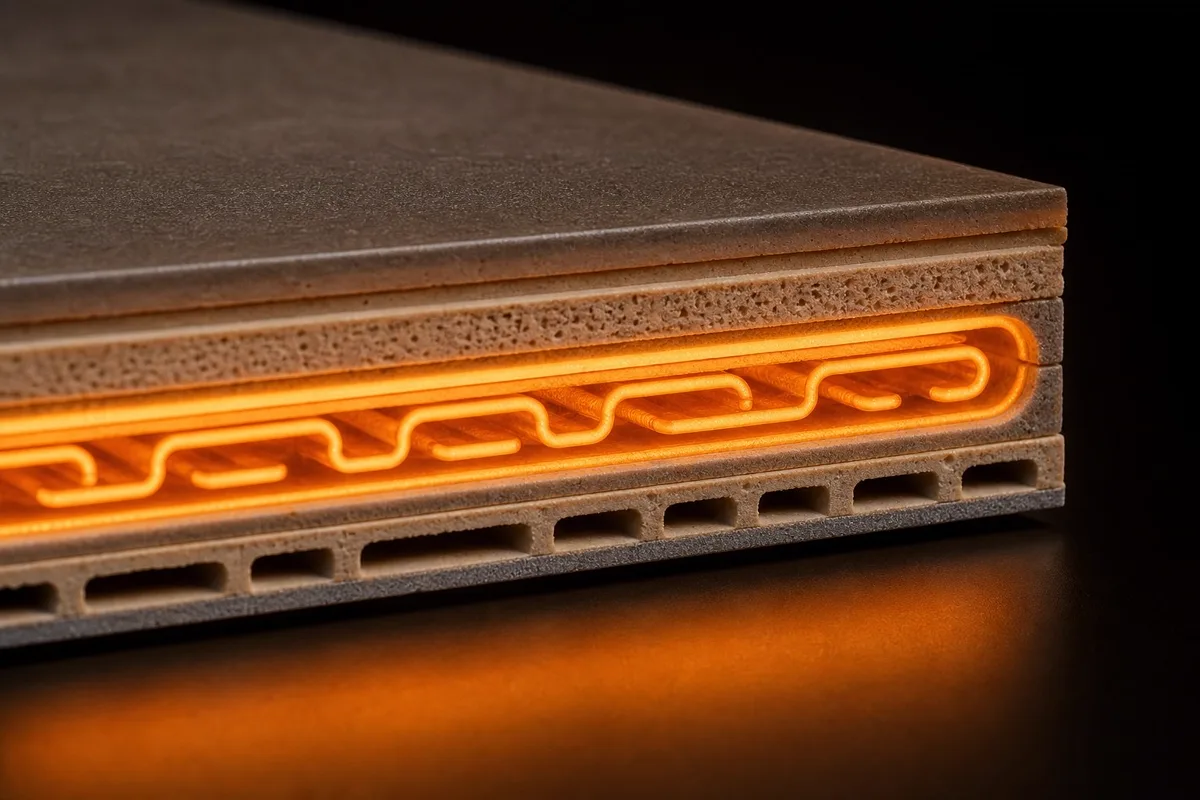
"Magneto-caloric" isn't a term you'll find from most infrared heating brands — for good reason. Most manufacturers rely on a simple, exposed nickel-chromium resistance wire behind a painted aluminium or glass plate. The SunWave Ceramica panel uses a different, patented heating element: a magneto-caloric paste combined with a conductive PET fibre mesh, protected under European patent EP 3 123 483 B1. This article explains what that term means, how the heating element is built, and what TU Dresden's independent measurements show.
What does "magneto-caloric" actually mean?
The magnetocaloric effect is a physical phenomenon known since the 19th century: certain materials change temperature when exposed to a changing magnetic field. Its best-known application is magnetic refrigeration, where the effect is used to generate cooling without conventional compressor refrigerants. The SunWave Ceramica heating element applies a related materials principle in the opposite direction: a specially formulated paste with magneto-caloric properties is combined with a conductive mesh of PET fibres (polyethylene terephthalate). When current flows through this mesh, it generates resistive heat — the magneto-caloric paste helps spread that heat evenly across the entire surface of the heating element, rather than concentrating it at individual points, as happens with an exposed resistance wire.
The result is a heating surface that reaches a very even temperature across its entire area — a prerequisite for the 6mm fine porcelain stoneware surface above it to radiate just as evenly, instead of showing warmer and cooler zones.
How the SunWave Ceramica panel is built
A SunWave Ceramica panel consists of several functionally coordinated layers. From the visible surface inward:
Fine porcelain stoneware surface (6mm)
Porcelain stoneware as the visible surface and radiating medium — chemically inert, scratch-resistant, available in several design variants. See our article on porcelain infrared panels for details.
Heating element: magneto-caloric paste + PET fibre mesh
The patented element (EP 3 123 483 B1) — converts electrical current into heat and distributes it evenly across the surface.
Insulation & backing (Class II)
Double insulation per EN 60335-2-30, measured leakage current of 0.1 mA (limit 0.25 mA) — Labor S.A.
Control unit & WiFi thermostat
Included from CHF 550 — remote control and scheduling via app.
Why this matters for radiant heat output
An even temperature distribution across the heating element is the prerequisite for what TU Dresden measured under DIN EN IEC 60675-3: an operating temperature of around 67°C and a resulting infrared peak wavelength of 8.52 µm — calculated via Wien's displacement law, which describes the relationship between a body's temperature and the wavelength of its peak thermal radiation. This wavelength falls within the long-wave (far) infrared range, which is absorbed particularly efficiently by water and tissue molecules — the physical reason radiant heat from infrared panels feels immediately warm to people, similar to sunlight.
A heating element with uneven temperature distribution, by contrast, would create zones with different surface temperatures and therefore different radiation characteristics — noticeable as "hot" and "cooler" patches on the panel surface.
Resistance wire vs. magneto-caloric element: the difference at a glance
| Property | Simple resistance wire (nickel-chromium) | Magneto-caloric element (SunWave) |
|---|---|---|
| Heat distribution across surface | localised, along the wire path | even across the whole surface |
| Typical carrier material | painted aluminium or glass | 6mm fine porcelain stoneware |
| Patent protection | usually none (standard component) | EP 3 123 483 B1 |
| Independent testing | varies widely by manufacturer | TU Dresden, Fraunhofer WKI, Labor S.A. |
| Basic conversion principle | electrical resistance → heat | electrical resistance → heat (more evenly distributed) |
An honest note on efficiency: magneto-caloric technology doesn't change the basic physics of electric resistance heating — 1 kWh of electricity still becomes roughly 1 kWh of heat, as with any direct electric heater. The difference lies in the quality and evenness of heat output, and in material stress over the panel's lifetime — not in a fundamentally different efficiency rating.
Manufacturing, certification and licensing
Licensing rights for patent EP 3 123 483 B1 are held by Feegoo Lizenz GmbH. SunWave Ceramica panels are manufactured by SunWave Heating Company SH.P.K. in Albania, under ISO 9001 (quality management), ISO 14001 (environmental management), ISO 45001 (occupational safety) and ISO 27001 (information security) certification, plus CE (Directive 2014/35/EU, RoHS 2011/65/EU) and UKCA. Every panel ships with 650W output, a 6mm fine porcelain stoneware surface, an integrated WiFi thermostat and a 5-year warranty — starting at CHF 550.
For more on the independent test results based on this heating element design, see our article TU Dresden Test Results: What the Measurements Actually Show and our research page.
Frequently Asked Questions
What does "magneto-caloric" mean for an infrared heater?
The term refers to the patented heating element inside the SunWave Ceramica panel (patent EP 3 123 483 B1): a magneto-caloric paste combined with a conductive PET fibre mesh, laminated beneath the 6mm fine porcelain stoneware surface. This combination spreads electrically generated heat evenly across the entire panel face, rather than creating localised hot spots as a simple resistance wire would — the basis for the even radiant heat TU Dresden measured at an operating temperature of around 67°C and a peak wavelength of 8.52 µm.
Is the magneto-caloric technology patented?
Yes. The heating element is protected under European patent EP 3 123 483 B1, which describes the magneto-caloric paste combined with conductive PET fibre mesh. The licensing rights are held by Feegoo Lizenz GmbH; SunWave Ceramica panels are manufactured by SunWave Heating Company SH.P.K. in Albania under ISO 9001, 14001, 45001 and 27001, plus CE and UKCA certification.
Does the technology make the panel safer or more efficient?
Both factors play a role. Even heat distribution across the surface avoids localised overheating — Labor S.A. (EN 60335-2-30) measured a surface temperature rise of 71.2 K, well below the 80 K limit, with a leakage current of just 0.1 mA (limit 0.25 mA) under Class II double insulation. On efficiency: like any electric resistance heater, the panel converts electricity to heat at close to 1:1 — the technology doesn't change this fundamental figure, but it delivers more even, material-friendly heat output over the panel's lifetime.
How does SunWave Ceramica differ from other infrared panels on the market?
Two points stand out. First, the surface material — 6mm fine porcelain stoneware instead of the painted aluminium or glass surfaces common among competitors, which results in a different radiant character and feel. Second, the heating element underneath: the patented magneto-caloric paste with PET fibre mesh (EP 3 123 483 B1) instead of a simple exposed resistance wire. Together, these two design choices underpin the three independent test results from TU Dresden, Fraunhofer WKI and Labor S.A. that ship with every SunWave Ceramica panel.
Experience the heating element that makes the difference
The SunWave Ceramica panel: 650W, 6mm fine porcelain stoneware, patented magneto-caloric heating element (EP 3 123 483 B1), independently tested by TU Dresden, Fraunhofer WKI and Labor S.A. From CHF 550, 5-year warranty.
View the SunWave Ceramica Panel →